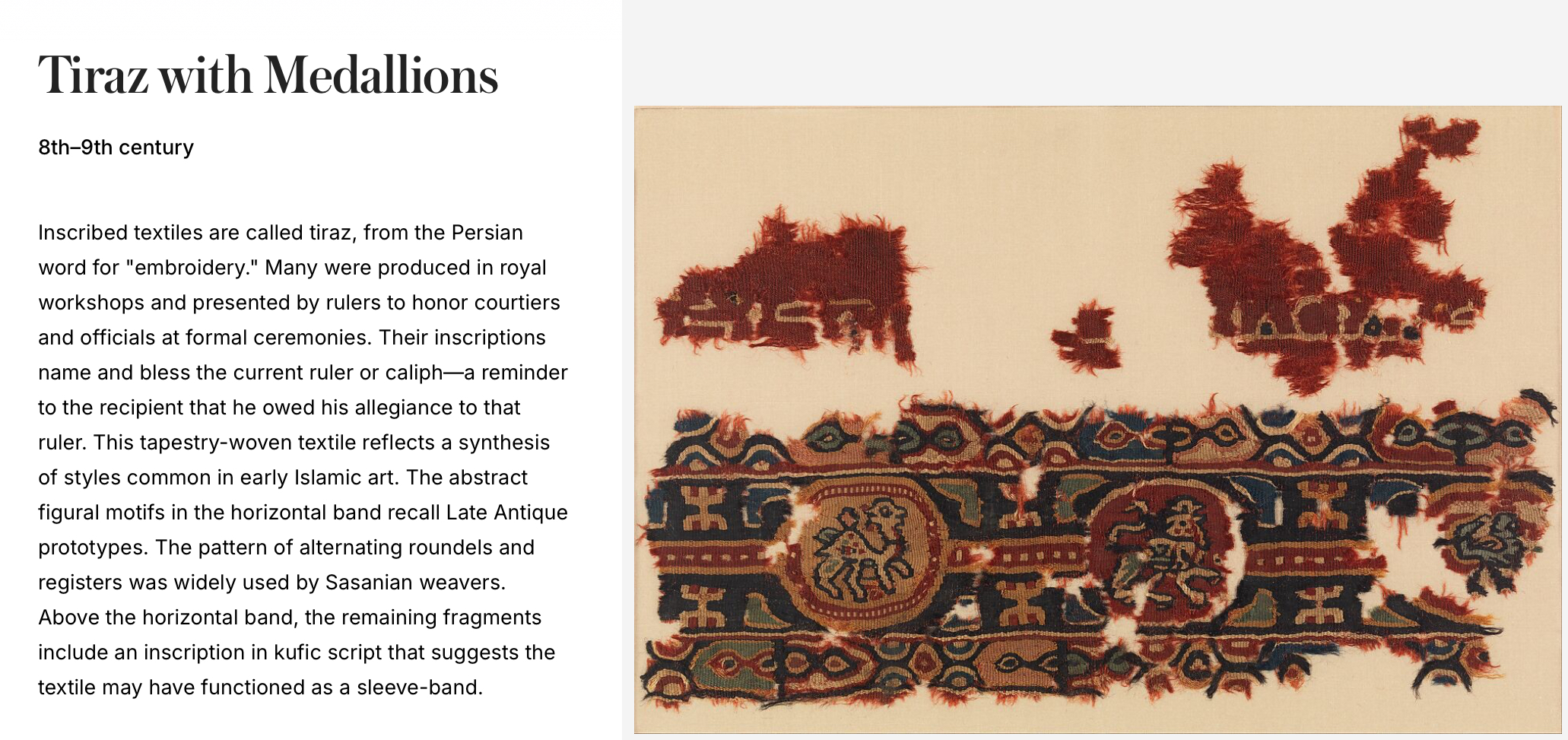
Tiraz with Medallions
Dublin Core
Title
Tiraz with Medallions
Subject
Wool tapestry woven textile
Description
Inscribed textiles are called “tiraz,” which is the Persian word for “embroidery.” The weaving of a tapestry into a textile sparked inspiration for common styles in early Islamic art. The abstract style of the figures reflect styles of Late Antique Islam. Furthermore, the alternating roundels were a common technique used by Sasanian weavers. They were gifted to honor officials, such as courtiers or military officers, during formal ceremonies. It was a sign of honor and loyalty to receive a tiraz. The inscriptions either states the name of or blessed the current ruler or caliph as a reminder to the owner that devotion and commitment to the ruler was crucial. A caliph was appointed and seen as the protector of the Muslim community. These textiles symbolized power and authority through tangible objects. The inscriptions also demonstrated early signs of religion intertwining with matters of government and political authority.
Source
Ekhtiar, Maryam, and Julia Cohen. “Tiraz: Inscribed Textiles from the Early Islamic Period.” Heilbrunn Timeline of Art History, The Metropolitan Museum of Art, July 2015. Accessed October 14, 2025. https://www.metmuseum.org/essays/tiraz-inscribed-textiles-from-the-early-islamic-period.
Date
8th-9th Century
Citation
“Tiraz with Medallions,” Etemadi, accessed November 16, 2026, https://coloradocollege.website/aetemadi/items/show/10.