Ibrahim ibn al-Mahdi
Dublin Core
Title
Ibrahim ibn al-Mahdi
Subject
Visual representation of Abū Zayd preaching in a mosque
Description
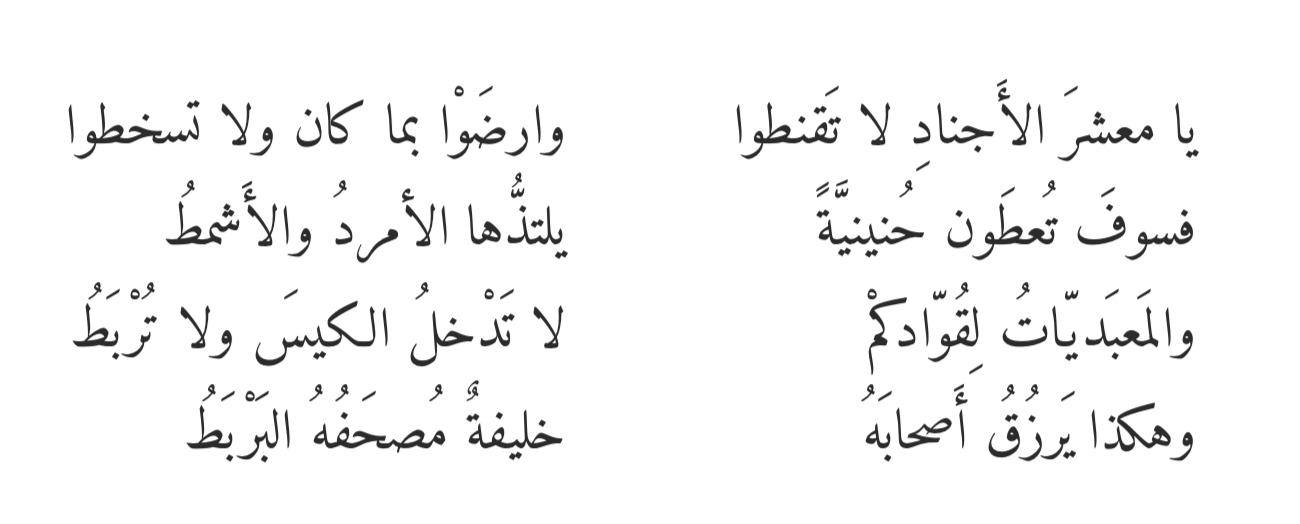
Poem written during the early ʿAbbāsid period of Ibrahim ibn al-Mahdi in response to his failure at gaining power and becoming caliph of Baghdad in 819. He attempted to establish himself as counter-caliph of Baghdad. He was supported by troops but he was not able to pay them and they mocked and berated him, saying that he was more fit to be a singer and poet than a ruler and that he could only “pay them in songs.” This moment revealed Ibrahim’s weak authority and the introduced the clash between political authority and poetry.
To summarize the poem, Ibrahim makes an underlying sarcastic effort to encourage his troops when he knows they are not going to get paid, and hints that they will get paid in a performance by a famous singer, Hunayn, and not actual currency, even for the higher ranking officers. His legitimacy as being a potential caliph is attacked and is reminded that his devotion and commitment lies in music and poetry rather than being a ruler. Given the significant influence of poetry, mocking poems like this had the potential to make a ruler look very weak and undermine all his authority and respect. There was a large dependence for rulers to have great loyalty and commitment to their military, and if they didn’t, they were not fit to be a ruler. These poems were not only a source of entertainment, but could also be used to criticize a person of authority and influence the community to believe a certain way about someone. Poetry was a powerful political tool given its influence and admirability by society.
To summarize the poem, Ibrahim makes an underlying sarcastic effort to encourage his troops when he knows they are not going to get paid, and hints that they will get paid in a performance by a famous singer, Hunayn, and not actual currency, even for the higher ranking officers. His legitimacy as being a potential caliph is attacked and is reminded that his devotion and commitment lies in music and poetry rather than being a ruler. Given the significant influence of poetry, mocking poems like this had the potential to make a ruler look very weak and undermine all his authority and respect. There was a large dependence for rulers to have great loyalty and commitment to their military, and if they didn’t, they were not fit to be a ruler. These poems were not only a source of entertainment, but could also be used to criticize a person of authority and influence the community to believe a certain way about someone. Poetry was a powerful political tool given its influence and admirability by society.
Creator
Di’bil al-Khuza’i
Source
Course material (Baghdād: From Its Beginnings to the 14th Century)
Date
817-819
Contributor
Beatrice Gruendler
Jens Scheiner
Isabel Toral
Jens Scheiner
Isabel Toral
Still Image Item Type Metadata
Original Format
Army troops, don't give up or put up with what was, and don't get upset,
You will receive a tune of Hunayn, enjoyed alike by beardless youth and hoary spinster And for your generals, tunes of Ma bad, which cannot be put into a purse and tied up.
Thus pays his army a caliph whose Koran is the lute.
You will receive a tune of Hunayn, enjoyed alike by beardless youth and hoary spinster And for your generals, tunes of Ma bad, which cannot be put into a purse and tied up.
Thus pays his army a caliph whose Koran is the lute.
Physical Dimensions
Location: Baghdad
Citation
Di’bil al-Khuza’i, “Ibrahim ibn al-Mahdi,” Etemadi, accessed November 16, 2026, https://coloradocollege.website/aetemadi/items/show/6.