Illustration of Religious Preaching
Dublin Core
Title
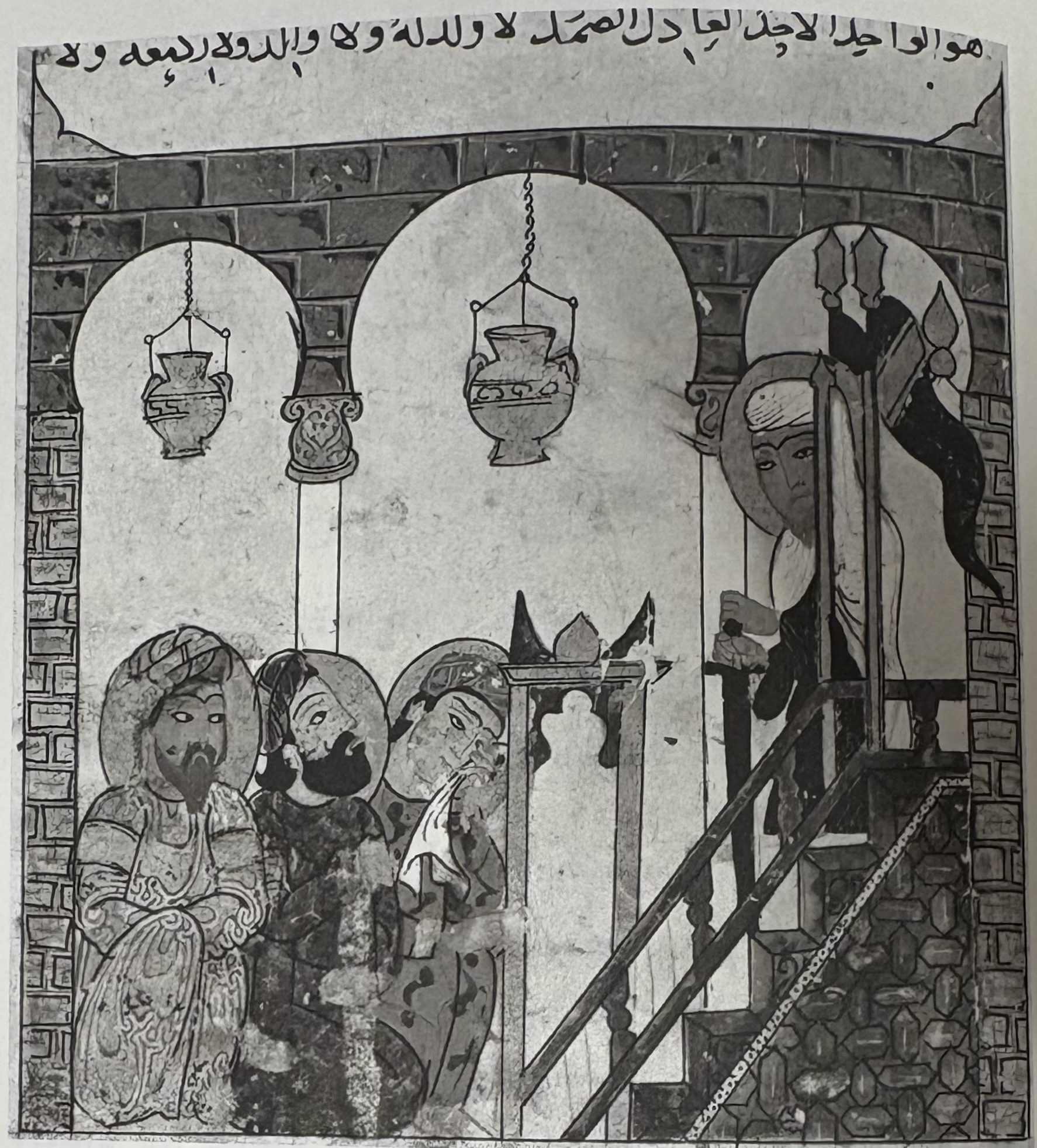
Illustration of Religious Preaching
Subject
Visual representation of Abū Zayd preaching in a mosque
Description
Islamic religious scholars (or the ulamā) was sent to the caliph’s court for the governor of Baghdad to ask them to publicly proclaim that the Qur’an was created, not eternal, because that is what the caliph believed. At this point, al-Ma’mūn, otherwise known as one of the greatest caliphs of all time, was currently caliph of the Islamic empire. Religious scholars usually believed that the Qur’an is the eternal words of God. Muslims in Baghdad also believed that the Qur’an must be eternal because God is eternal, and the text is from God Himself. Al-Ma’mūn disagreed because they believed only God is eternal, unlike all things created, and all things created cannot be eternal. He insisted that the ulamā preach to the public that the Qur’an is created, therefore it is not eternal, as everyone thought it is. The conversation between the governor, Ishāq ibn Ibrāhīm and one of the Baghdadi ulamā, ‘Alī ibn Muqātil about the Qur’an was very interesting. Ali kept insisting that the Qur’an is the word of God, not created by God, but proceeds to say that is the caliphs commands something of the people, they must listen and obey.
The image represents the nature of public religious preachings of sermons and statements that would be recited aloud to large gatherings of people in attempt to spread the word of God. The visual shows the preacher on an elevated platform while reciting the Qur’an to the community, symbolizing how important religious leadership and authority was. Religious authority was very difficult to obtain because, traditionally, the ulamā held religious authority and interpreted the Qur’an to establish rules and social norms, but al-Ma’mūn asserted that it was the ultimately the caliph who held religious authority.
The image represents the nature of public religious preachings of sermons and statements that would be recited aloud to large gatherings of people in attempt to spread the word of God. The visual shows the preacher on an elevated platform while reciting the Qur’an to the community, symbolizing how important religious leadership and authority was. Religious authority was very difficult to obtain because, traditionally, the ulamā held religious authority and interpreted the Qur’an to establish rules and social norms, but al-Ma’mūn asserted that it was the ultimately the caliph who held religious authority.
Source
Selove, Emily, ed. Baghdad at the Center of a World, 8th-13th Century: An Introductory Textbook. Theran Press, 2019.
Date
833 CE
Still Image Item Type Metadata
Original Format
Location: Center of the City of Baghdad
Citation
“Illustration of Religious Preaching,” Etemadi, accessed November 16, 2026, https://coloradocollege.website/aetemadi/items/show/19.