Riddles Suggested to the Learned
Dublin Core
Title
Riddles Suggested to the Learned
Subject
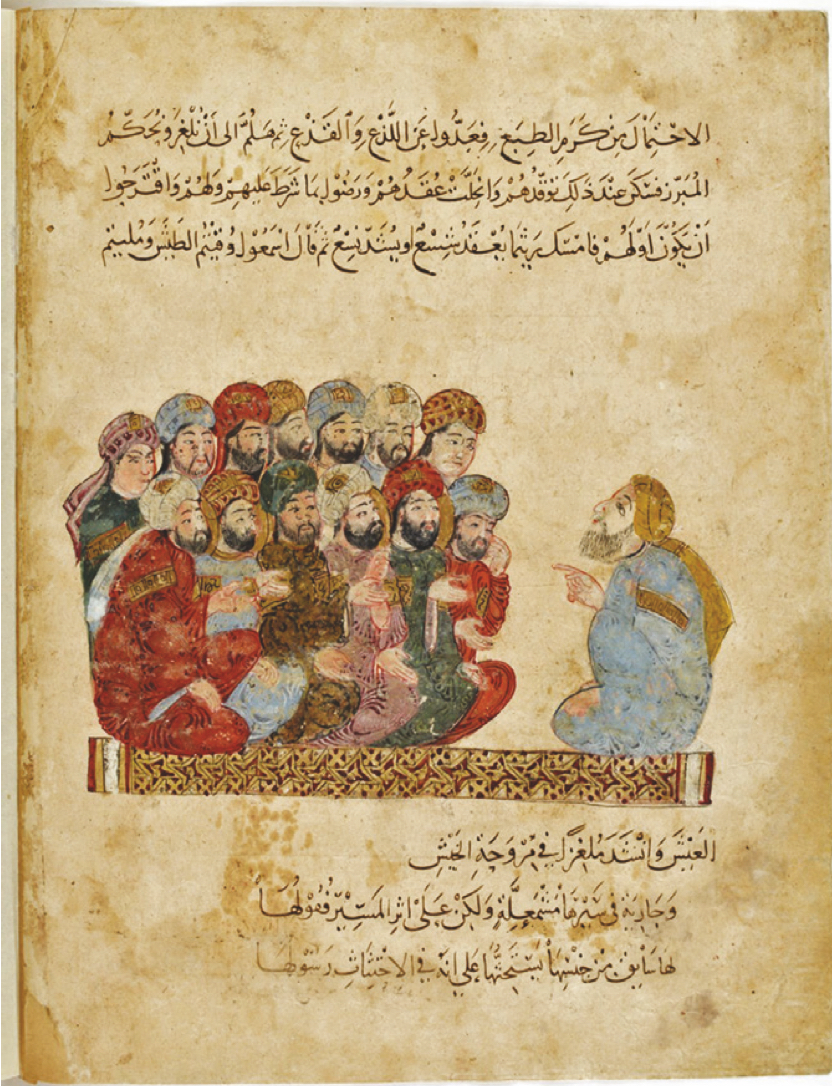
Visual representation of a challenger suggesting riddles to Islamic scholars (ulama)
Description
Riddles emerged in the 10th century as an integration of poetry to a more intellectually conceptual narrative. Riddles gained popularity in major cities of knowledge expansion and advanced intellect. Regions that were typically more educated and emphasized broadening of insight rooted the concepts behind riddles. While poetry was more seen as a form of entertainment, riddles contained expressions of intelligence and mastery. The visual representation depicts the attentiveness of a group of religious scholars, which would be considered the elites of literature, to the challenger, or the one delivering the riddle to the ulama. On literature itself, often integrated in poetry was the use of language, and Arabic was the common ground for verbal expression among diverse groups and ethnicities. Since the Qur’an is written in Arabic, it was seen as a culturally significant and prestigious language. The mastery of the Arabic language gained a nuance of intellectual authority, and had influence over the structure of social status. The Maqāmāt genre is the term that describes riddles. They incorporate deliberate narratives delivered in a challenging manner to stimulate cognitive intellect to piece together the solution to the riddle. The genre was originated by Badiʿ al-Zaman al-Hamadhani.
Source
Course Material (Baghdād: From Its Beginnings to the 14th Century)
The Editorial Team. “Literature and Music in Muslim Civilisation.” Muslim Heritage, April 11, 2007. Accessed October 15, 2025. https://muslimheritage.com/literature-music-muslim-civil/.
The Editorial Team. “Literature and Music in Muslim Civilisation.” Muslim Heritage, April 11, 2007. Accessed October 15, 2025. https://muslimheritage.com/literature-music-muslim-civil/.
Date
10th-12th Century
Citation
“Riddles Suggested to the Learned,” Etemadi, accessed November 16, 2026, https://coloradocollege.website/aetemadi/items/show/20.