Arnest the Professor
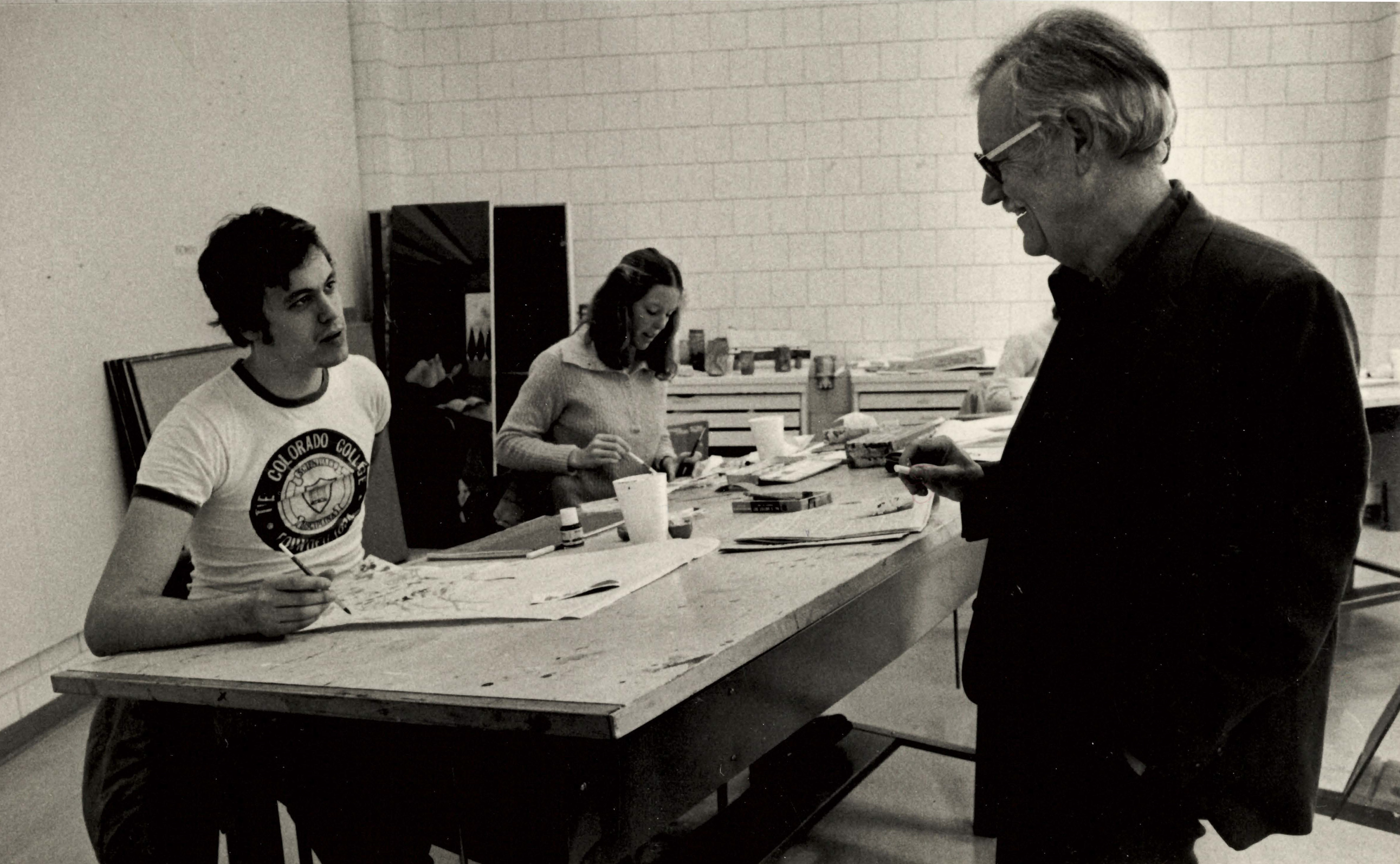
Photo from 1970s CC Bulletin of Arnest with students. Colorado College Special Collections.
After his service, Arnest lived in New York and established a relationship with Kraushaar Galleries (which would last until his death 39 years later and produce seven one-man shows). He quickly began to feel the struggle of being an artist in a post-war economy. He recalled: “I was borrowing money from friends and I needed something. I don’t know what I would have done otherwise.”[1] Fortunately for Arnest, through the recommendation of former instructor, Henry Varnum Poor, he secured a teaching position in Minneapolis in 1947.[2]
Arnest was chief instructor in painting at the Minneapolis School of Art (now the Minneapolis College of Art and Design, or MCAD) until 1949, at which point he began working in the Art Department at the University of Minnesota. At the latter, Arnest rose to associate professor of art and then chair of the Master of Fine Arts degree committee. Arnest returned to Colorado in 1957 as chair of the newly-consolidated Colorado College art department. In an interview, Arnest recounted:
I got an inquiry from Fred Bartlett… then head of the Fine Arts Center, asking me if I’d be interested in being the chairman of the newly consolidated college art department… So when an opportunity came to be—to have some influence on an art program on a small scale… I thought it was worthwhile doing.[3]
And influence the program, he did. Over the 25 years Arnest worked at CC, he served two terms as chair: one during his first 17 years at the college, one during his last three.
Observation was a crucial part of Arnest’s pedagogy, in line with the methodology of his former instructors Varnum Poor and Boardman Robinson. Arnest aimed to create a department that valued discernment as much as technical proficiency. He explained the importance of critical analysis in the Colorado College Bulletin:
In order to be a good artist, you have to be interested in more than your own art… What I try to teach and what the department tries to teach, are the foundations, if not of connoisseurship, at least of judgment, learning to discern quality, especially in these time when there are no main currents in the art world. Everything is amorphous. Anything goes. It’s extremely confusing for the students.[4]
For his Art Studio students, he emphasized the importance of close-looking as an art practice: “[W]hen [students] have to make a painting, for example, they have to look at a painting… much more carefully, in much more detail, much more thoughtfully, than they’re in the habit of doing…”[5]
Still, despite the great amount of time and effort Arnest invested in teaching, his primary concern was with painting. When asked whether he always enjoyed his role as a professor in an interview months before his retirement, he joked, “No… Never!” [6]and suggested that he’d rather paint. The question was one Arnest heard many times over the years and the response he gave in interview was his most direct answer, but, after the unsatisfying reception of Scenes from Life, he was undoubtedly eager to devote more time to his practice.
[1] Diane Wengler, “Bernard Arnest: An Artist for All Seasons,” Colorado Springs Gazette Telegraph, January 17, 1981, 12.
[2] Bernard Arnest, interview by Judy Finley, Colorado College Archives Oral History Project, Tutt Library Special Collections, January 12, 1982, 19.
[3] Arnest, interview by Finley, 24-27.
[4] B.N., “Faculty Profile: Bernard Arnest, Artist and Teacher,” Colorado College Bulletin, December 1981, 16.
[5] Arnest, interview by Finley, 41.
[6] Arnest, interview by Finley, 43.