

By Sam Damore
December 19th, 2018

The internet was one of the most profound developments of the 20th century. Today, 3 Billion people have access to the internet. There are nearly 1.5 billion people on Facebook, 1 billion on Google and 900 million on whatsapp[1]. There isn’t an international border that the internet does not cross. During the internet era, humanity uploaded our collective knowledge onto a virtual network that could be accessed by nearly every individual on earth at the click of a button. This would allow computers and human beings to come together in extraordinary ways. Without the internet, many of the world’s most valuable companies would not exist: Amazon, Facebook, Instagram, eBay, Alibaba and Netflix could not exist. College students are often advised in the 21st century, that in order to make money after graduation, they should study computer science and work in the tech industry. That being said, the tech industry hasn’t always been economically prosperous. The mid 1990s and early 2000s were an especially tumultuous period for tech in America. During the period from 1995-2001, thousands of internet companies came to life. Their goal of change the world and to get rich doing it. Although some of these companies evolved into colossal corporations, many of them failed miserably. In order to understand how the modern internet industry and startup landscape was shaped , one must start by looking at the company that started it all: Netscape. Originally called X Mosaic, Netscape introduced internet users to the world of cyberspace through the Netscape Navigator, the world’s first web browser. Netscape’s rapid growth gave millions of people a glimpse of the technological awe that was the internet. This fueled a wave of positive publicity that glamorized Netscape as the magnificent ruler leading us into a new economy. It also inspired a generation of tech junkies by showing them that you could make a meaningful impact on the world through coding and that you could capitalize on it. It was Netscape’s success that made startups seem sexy. Unfortunately for founders and investors, the Internet’s early hype was too good to be true.

Several developments were necessary before the internet could infiltrate the daily lives of the American people. The most important of these developments were the personal computer, ARPANET, and the World Wide Web. Together, these technological innovations would help provide Netscape with the ability to reach millions of users and make billions of dollars.

The story of the internet could not be told without mentioning the story of the personal computer. It was the personal computer that allowed the internet to reach the vast population that it does today. Before the Apple and Microsoft, computers were not very accessible to the average individual. In 1976, Steve Jobs and Steve Wozniak created the Apple 1, the first microcomputer to be a commercial success. In 1977, Bill Gates and Paul Allen wrote software for the microcomputer and they called it Microsoft.[2]However, even after the initial success of Apple and Microsoft, personal computers were still quite esoteric to the average American. You could play computer games on PCs, but you didn’t need to rely on using them in your daily life. The development necessary to kickstart the mainstream use of personal computers was the internet.

The Internet began as a computer network that was created in the midst of the Cold war. During the 1960s, nuclear tension between the United States and the Soviet Union was high. The Pentagon felt that the United States desperately needed a decentralized communication system that could survive a nuclear attack. Imagined was a distributed network that had no central point susceptible to attack.[3]The military communications tool that the United States was looking for was ARPANET. Funded by the Defense Advanced Research Projects Agency (DARPA), ARPANET was born in 1969. In its early years, ARPANET was connected to computer nodes at four different academic institutions: Stanford; the University of California, Santa Barbara; the University of California, Los Angeles; and the University of Utah. By 1971, an additional fourteen nodes were added to the network. By 1973, the network contained over forty nodes.[4]This was the beginning of the free global internet. However, early computer networks were limited in that they mostly served to facilitate discussion amongst the scientific and academic community. These networks weren’t exactly friendly to the average user. The World Wide Web would change this.

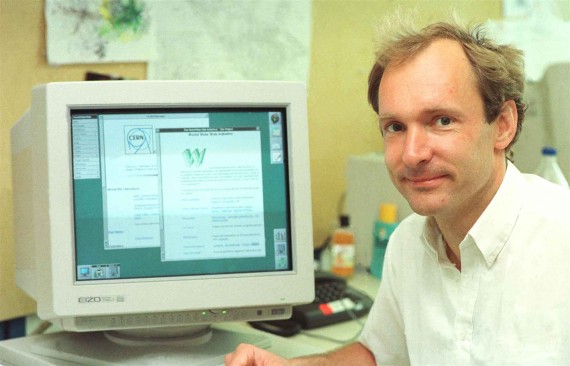
The World Wide Web (WWW) was created by Tim Berners-Lee in a Swiss physics lab in 1990. Tim’s invention made it so that files on the internet had their own labels, called hypertext.Through hypertext, Internet users could jump from to and from these files by clicking on the labels. This vastly increased the accessibility of the internet. Berners-Lee then created the world’s first website: www.info.cern.com.[5]Despite this increased accessibility, something still needed to web before its actual potential could be realized. Before 1993, activity on WWW accounted for less than one percent of the internet’s total traffic.[6]The internet was ready for a user-friendly browser to view to web.
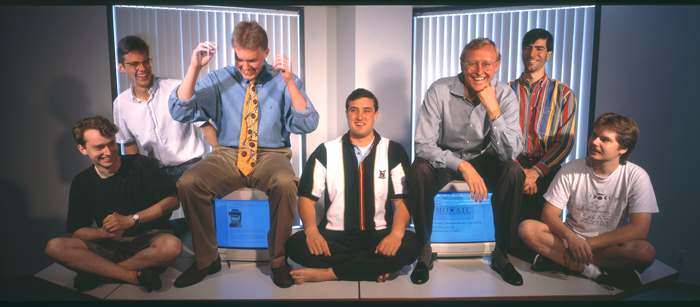
The Netscape Navigator was the world’s first commercially successful web browser. Netscape was founded in 1994 by Marc Andreessen, a College student from Illinois. In 1994, Netscape was huge. Before it blew up, Netscape’s early prototype was adding 600,000 new users every month.[7] It started to seem like Netscape was the face of the entire internet. At the time, if a person wanted to use the internet, it is highly likely that they would have done so using the Andreessen’s creation. For this reason, the Netscape browser provided people with their first look into cyberspace. It revealed that a instant worldwide access to information could provide some tremendous opportunities for coders. America would become even more motivated to join in on the internet hype after they observed the riches that it could produce.

As Netscape started gaining traction, stories about Andreessen and the Internet economy began to generate immense buzz. In 1994, Fortune Magazine declared Marc Andreessen one of America’s top talents under 30. Netscape’s story was unorthodox at the time, and Fortune noted that Netscape’s emergence represented a unique change in the American business environment. In Fortune’s story, Andreessen says, “six of 25 engineers do not have college degrees.”[8]Netscape’s early success made it seem as though the internet was about to revolutionize the world. It wouldn’t be irrational for the average person to read the news and believe that the internet was here to stay and that a mysterious new industry would transform the global economy. After all, the internet and the industry it created was here to stay. As a result, when Andreessen decided to take Netscape public, investors were eager to join in on the future.
Netscape went public in 1995 at an initial public offering of $28. This was extremely unusual, as the company only had revenues of $17M. In addition, Netscape had only been in existence for a couple years. Despite this, Netscape was worth 2.1 Billion at the end of its first day trading. When trading closed on August 9th 1995, Netscape’s stock was valued at $58. At the end of 1995, it was $174.[9]
After Netscape’s IPO, Marc was a billionaire and his employees were millionaires. This triggered a tremendous amount of press in magazines like Wired and Time. Time Magazine featured Marc on the cover of its September 1995 Article titled, “High Stakes Winners: Meet the Get-Incredibly-Rich-Crowd. Their Creativity and Drive Reap Vast Rewards in the Stock Market. Otherwise, They’re Just Plain Folks.”[10] Just as the Fortune article had done in 1994, Time called attention to the fact that Netscape was changing the idea of startup could really become. The Cover of the issue shows a barefooted Marc in a t-shirt and blue jeans: not the image of the typical American Billionaire.
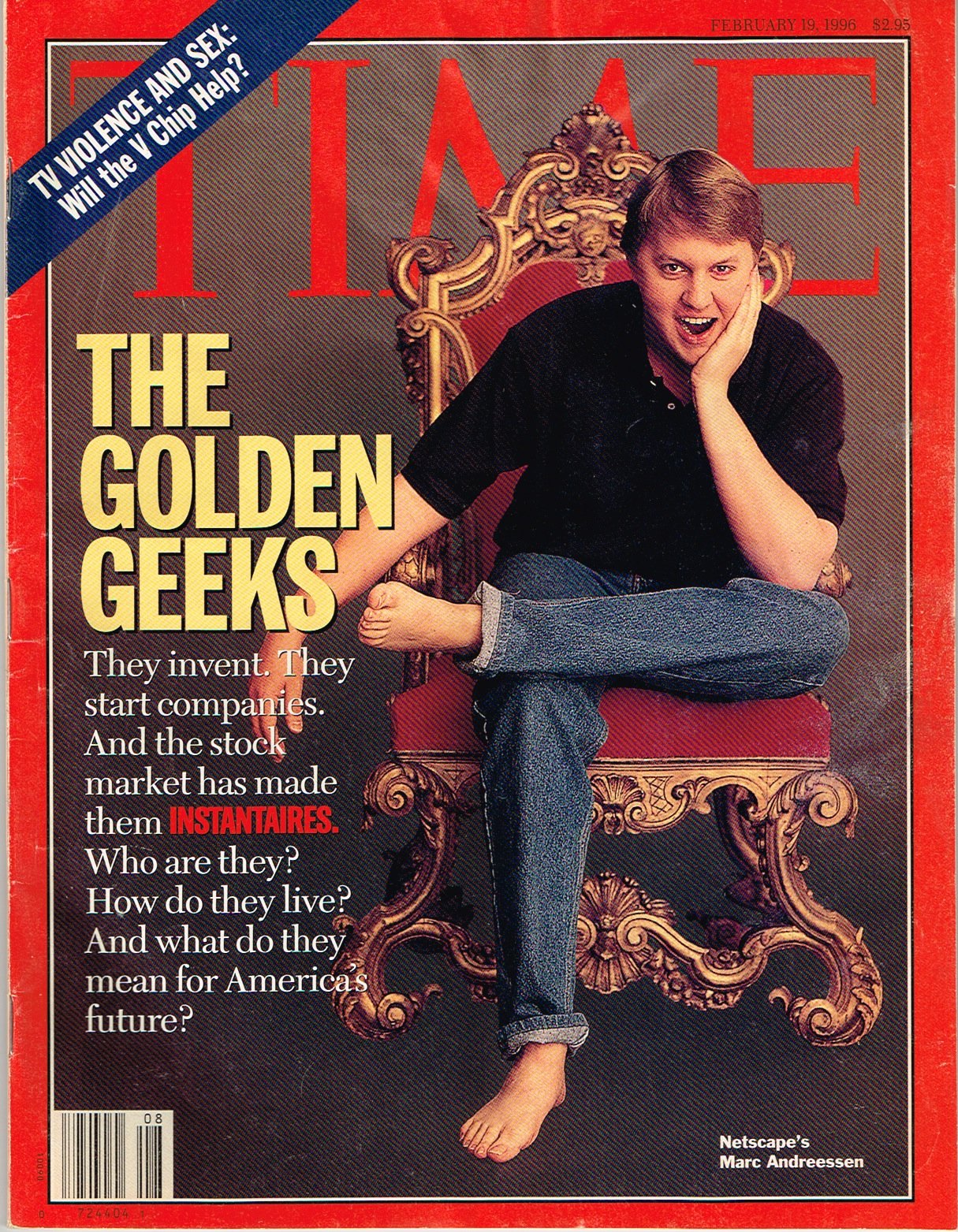
After the press coverage, it seemed as though Netscape’s IPO was officially the beginning of a new era. Time Magazine was certainly bullish about the internet’s future, stating that, “I don’t think there was ever a period when wealth was created so instantly through the market as it is today.” America’s fascination with the story of Netscape drew an explosion of both founders and investors to the internet industry. Unfortunately, they would learn the hard way that getting rich quick is too good to be true. Netscape was an unbelievably important technology and its value as a business certainly deserved to be recognized. However, Netscape’s importance was overblown. The enormous publicity around Netscape and the internet would inflate Netscape’s value as an investment and create the massive speculation of internet companies that led to an economic meltdown.
By publicizing the riches that the internet could create, countless entrepreneurs from across the country were drawn to the idea of starting a tech company. Lou Montulli, a cofounder of netscape, is quoted as saying, “The press just take what they think is most interesting, juicy and fascinating out of their limited time and they publicize that. Especially post-Netscape, in 1998, 1999, every startup was trying to do the things they read about in magazines.”[11]Many internet companies were created during the latter half of the 1990s. Some companies founded during this time include Pets.com, Amazon, Flooz, eToys and eBay.Many of these internet companies that thrived during the late 90s are no longer around. At the time, it seemed like any technology that had to do with the internet could get funding. It made sense, Internet companies were making people rich! $1,000 of Yahoo! stock in 1998 was worth $46,000 by 1999.Investors threw away their traditional investing fundamentals away search of riches in the new economy. Many internet companies were no longer valued by their income. In some ways, it was seen as a good sign if the company was millions of dollars in debt. The more money they spent scaling up, the more users it could reach. The more users they could reach, the more it was worth. Their mission was to get big fast and gain as much market share as they possibly could. If the web traffic on a company’s website was increasing, its value increased. The opposite was also true. However, because investment in these firms wasn’t judged by profit, their price fluctuation became purely speculative. Unbeknownst to many, this meant that the tech industry was officially inside of a speculative bubble. This bubble continued to gain momentum into the 21st century. At the peak of the internet bubble, Amazon’s stock was worth $61,000.[12] in 1999, Jeff Bezos was Time Magazine’s man of the year.

Slowly but surely, the tech companies that were overvalued began to dissolve. The entire tech industry began to drown and only the strongest would survive. In April of 2001, Amazon’s stock was worth $3,400.[13] Many of these failing tech companies were receiving funding that they obviously shouldn’t have. One such company was iHarvest.com, a service that would save online webpages for you. However, the bookmark function had already been implemented on most web browsers. IHarvest.com received $6.9 million in funding. [14] However, there were other failing companies that seemed like foolproof investments at the time. Unfortunately, Netscape was one of these companies. Somehow, the amazing web browser that nearly broke the stock market in 1995, would cease to be an important part of the internet by the end of the 1990s. Overtime, alternative web browsers like Internet Explorer were developed and users seemed to like them more than Netscape.

Although the majority of internet startups collapsed during the first five years of the internet era, there were a few important companies that survived. Such companies include Amazon, eBay, Priceline, Yahoo! and Google. Nearly two decades after the crash, tech companies are the leaders of the world economy. As of October 2018, the largest companies in the world by market capitalization are Apple, Google, Microsoft, Amazon, Tencent, Berkshire Hathaway, Alibaba and Facebook.[15]Seven of these are tech companies and five of them are internet companies.

In popular culture, the tech world is publicized by TV shows like Silicon Valley or movies like the Social Network. They depict the stereotypical view of the American tech startup. Typically, the tech entrepreneur is portrayed in the media as a young and intelligent college aged male who teams up with a group of his college buddies and spends a couple months coding in a small unhygienic space until the funds are raised to rent an office space. Then, they have a breakthrough and make millions. In reality, the stereotypes are embarrassingly accurate. That’s because Netscape defined the internet era and set the template for the future of high growth internet companies. First, Andreessen dropped out of college and moved to the Silicon Valley, then he used his technical knowledge to form a startup that would capitalize on the internet’s beautiful platform. After that, he went on to gather some venture funding on Sand Hill Road, gain millions of product users, generate press, go public on the stock market, and become a billionaire. Then, reality kicked in. By the late 1990s, it turned out that Netscape wouldn’t be as important as people thought it would be. In the end, Netscape’s web browser would inspire other entrepreneurs who would create better products.

Netscape was the first true dot com company. Pets.com, Yahoo!, Myspace, Facebook, Uber and Airbnb all share something in common with Netscape. They were all started by a group of smart, young and naïve technologists who felt they had nothing to lose by attempting to change the world with a revolutionary idea. When they started to gain traction, their wacky new ideas generate huge amounts of speculation by journalists, investors and average joes. However, the initial speculation is always tricky.
Sometimes their business idea succeeds, like Amazon.

Sometimes they are beat out by other companies that improve upon the technology. Although developing a web browser was the right idea, internet explorer beat out netscape. Similarly, myspace helped pioneer social media, but facebook would be a more valuable platform in the end.

Sometimes they fail miserably, like Pets.com.

In the internet era, technological innovation is the every day. In 2018, investors are aware of this and they act accordingly. In 1995, America was unprepared for this change. When people thought Netscape would change the world, people thought that any website would change the world.
[1]McCullough, Brian. How the Internet Happened: From Netscape to the IPhone. New York: Liveright Publishing Corporation, a Division of W.W. Norton & Company, 2018.
[2] Ibid.
[3]Ryan, Johnny. A History of the Internet and the Digital Future. London: Reaktion Books, 2013.
[4]Ibid.
[5]Ibid.
[6]Cassidy, John. Dot.con: How America Lost Its Mind and Money in the Internet Era. New York: Perennial, 2003.
[7]McCullough
[8]Collins, James. “HIGH STAKES WINNERS.” Time. February 19, 1996. Accessed December 19, 2018.
[9] Motley fool
[10]Collins.
[11]“20 Years On: Why Netscape’s IPO Was the “Big Bang” of the Internet Era.” Internet History Podcast. Accessed December 19, 2018.
[12] McCullough
[13]Ibid.
[14] Cassidy.
[15]Picardo, Elvis. “Eight of the World’s Top Companies Are American.” Investopedia. October 20, 2018. Accessed December 19, 2018.
Works Cited
“20 Years On: Why Netscape’s IPO Was the “Big Bang” of the Internet Era.” Internet History Podcast. Accessed December 19, 2018. http://www.internethistorypodcast.com/2015/08/20-years-on-why-netscapes-ipo-was-the-big-bang-of-the-internet-era/.
Cassidy, John. Dot.con: How America Lost Its Mind and Money in the Internet Era. New York: Perennial, 2003.
Collins, James. “HIGH STAKES WINNERS.” Time. February 19, 1996. Accessed December 19, 2018. http://content.time.com/time/subscriber/article/0,33009,984131-1,00.html.
McCullough, Brian. How the Internet Happened: From Netscape to the IPhone. New York: Liveright Publishing Corporation, a Division of W.W. Norton & Company, 2018.
Picardo, Elvis. “Eight of the World’s Top Companies Are American.” Investopedia. October 20, 2018. Accessed December 19, 2018. https://www.investopedia.com/articles/active-trading/111115/why-all-worlds-top-10-companies-are-american.asp.
Planes, Alex. “The IPO That Inflated the Dot-Com Bubble.” The Motley Fool. August 09, 2013. Accessed December 19, 2018. https://www.fool.com/investing/general/2013/08/09/the-ipo-that-inflated-the-dot-com-bubble.aspx.
Ryan, Johnny. A History of the Internet and the Digital Future. London: Reaktion Books, 2013.
Sellers, Patricia. “Meet America’s Top Talents under 30. They Are Unorthodox, Rebellious, and a Challenge to Manage.” Skullcandy: The World’s Coolest Headphones – Dec. 30, 2008. 1994. Accessed December 19, 2018. http://archive.fortune.com/magazines/fortune/fortune_archive/1994/12/12/80043/index.htm.
