

Manuel Castells, a foremost sociologist of the concept, argued that today’s society is a network society — ‘a network society is a society whose social structure is made of networks powered by micro-electronics-based information and communications technologies.’’ Social media platform is the answer to the general demand for networking. With the development of technologies and the social awareness of information exchange, social media platforms are presented unprecedented opportunities and challenges. However, the growth of online social media offers individuals a convenient way to reach out to and connect with broader circles of society while creates a prison that limits individuals to acquire information outside ones’ social bubble — the Filter Bubble.
Background
Society, as defined in the dictionary, is the aggregate of people living together in a more or less ordered community. In other words, society is based on the interaction between individuals, such as communication. Information is a
Arguably, mail is the first form of information exchange media. It can be traced back to 255 BC in Egyptian. Mail service is still essential in modern society, however, not as a tool for information exchange. Information has expiration date and mailing could take a long period for information transmission. Without the real-time quality, mail service is not an ideal communication media.
As we entered the modern era, more communication technologies were invented. In the 19th century,



In the late 20th century, with the vast development of hardware, internet joined the battleground. In the 1970s, e-mail system based on ARPANET and CompuServe were constructed. The e-mail was the first online communication tool for both individual and group communication while CompuServe was a public platform for news and community chat. These two applications introduced the concept of the
Limitation of early social media platform
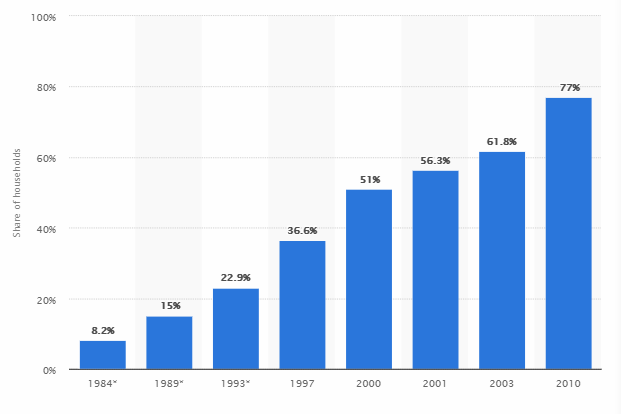
Limited by the shortage of personal computer, even after the introduction of the concept of online communication platforms, the development of social media service was slow in the 20th century. By 1984, there was only 8.2% of households in the United State with a computer at home. And by 1989, only 15% of households had a personal computer. That being said, in the early stage of the Internet era, the demand for the
RS-80 Color Computer, a relatively cheap device, was introduced in 1980. It triggered a small increase in communication platforms. According to stats from CompuServe, by the first quarter of 1981, there were more than 10,000 subscribers. However, the distribution of usage stated that it was still not popular personal service, 5% for newspaper and 20% for online chattings. Radio Shack. By early 1984, CompuServe hit the milestone of 60,000 subscribers. There was a relative huge increase while the final number of subscribers was still not large comparing to the number of households with a computer at home. In 1984, 85.41 million households were presented in the
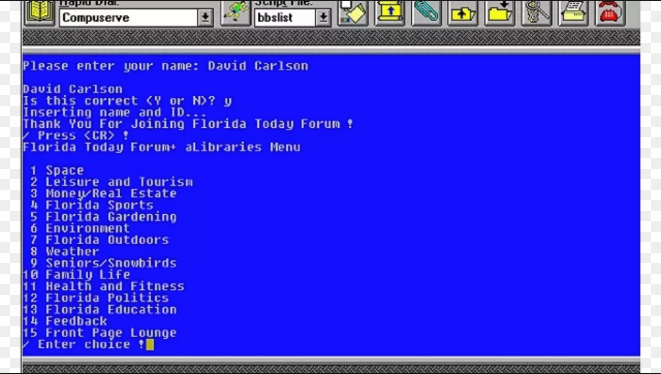
Clearly, the popularity of personal computers was not the only reason contributing to the limitation in social media platform development. Comparing to modern internet stream fees, the cost for internet service was expensive. According to stats from CompuServe, by early 1984, the site was charging 13 cents per minute of access during the day and 10 cents a minute at night while, in 1985, mailing a letter with a first-class postage stamp only cost 22 cents. For the record, the fastest modems were only 300 bps, meaning slow streaming speed, as it would take 6.2 hours to download the equivalent of an average newspaper. The cost made online chatting a luxury, with the
In addition, there was another issue in the early stage of social media platforms in the
However, CompuServe was able to contribute $68 million to H&R Block’s sales and $8 million in operating profits by April 30, 1989. In the 1980s, the first stage of social media platform services, even with the lack of customers, the social media market started to demonstrate its potential in the technology industry.
Tryouts before the dotcom bubble
In the 1990s, with a sharply up presented in personal computer possession, some people started to value the potential of online social media platforms. Revenue for the platforms built in the
According to the stats, by 1993, 22.9% of U.S. households owned at least a personal computer, and by 1997, the number increased to 36.6%. The vast increase in the
Besides the ones inherited from the 1980s, two social media platforms with more advanced technology and ideas were established, Classmates.com and SixDegrees.com. While Classmates.com was specifically aiming for alumni community, SixDegrees.com was more targeted at more abstract community that people could define their own communities. According to the stats from Bureau of Labor Statistics (referred as BLS for the rest of the paper), in the 1990s, two-thirds of the households from top 20-percent income group owned personal computers. That being said, the potential customers of online social media services could be considered


With the correct target, Classmates.com succeeded at the time and even survived until today. In the
Targeting at self-constructed communities, SixDegrees.com had a push start. According to BLS, population owning a personal computer started to become diverse in the 1990s, such as more Asians and black people could afford the cost. That being said, demand for online communities of diverse groups entered the market. And, unlike the Classmates.com, SixDegrees.com was more a free personal extended network. Customers were allowed to create their own profiles and to invite friends. The model succeeded in the early stage, and by 1998, SixDegrees had over 1 million user base. However, with lack of profit method, SixDegrees tried Business-to-Business mode by selling user data to advertisement companies and working with an online shopping software. The founders did not realize that SixDegrees was based on the free and clean self-selected community, and by adding spam information, users would easily switch to other. Shortly, SixDegrees was closed in 2000, when the
Effect of dotcom bubble
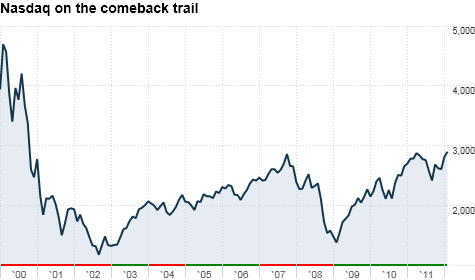
March 2000, the dotcom bubble burst. Stocks of tech companies such as eBay and Amazon dropped dramatically, and websites such as pet.com and Worldcom failed and shut down. Most communication companies and e-commercial companies took a serious hit while social media, the under-developed Internet section, did not suffer much. However, SixDegrees was still largely affected by the burst of the Internet bubble.
As I mentioned, SixDegrees was a free social media platform, and in the
Yet, it is still reasonable to say, instead of a catastrophe, the dotcom bubble actually presented an opportunity for social media industry. E-commercial, as the major role in the dotcom bubble, motivated the development of online advertisement. However, before 2000, the advertisement was mostly banners and pop-ups. Lack of the accurate advertisement also contributed to the spam-like online advertisement. The problem was mostly because of the under-developed social media platforms leading to low-value user data. The dotcom bubble, while wiping out numerous Internet companies, was also removing the low-quality online advertisement from the market. In the early 2000s, a relative acceptable advertisement mode was introduced by Google with contextual content and pay-per-click charging. This mode requires useful user data to implement accurate advertisement so that customers are receiving favored information instead of spam. That being said, the ideal environment would be search engines and social media platforms.
The dotcom bubble also revealed the an essential component of dotcom companies — user base. During the bubble, most of the companies with established profit modes failed because of the lack of customers while Netscape, a communication company with no profit method, survived. The success of Netscape in the dotcom bubble introduced the Get Big Fast model, as market share now equals revenue in the future, to the dotcom industry. It provided confidence to investors to invest money into dotcom companies with negative revenue but increasing user base. Such planet was ideal for social media platforms. SixDegrees was successful in getting big fast, however, failed because it pushed too much into profit modes without a concrete user base.
During the bubble,
Development in the 2000s
In the 2000s, after the



In 2004, at Harvard, Mark Zuckerberg implemented Facemash, later became Facebook. At the first stage, it was similar to Classmates.com, only open to Harvard students. It was a platform for an enclosed Harvard community. In early 2005, Facebook expanded to 21 other universities. After built up the fame and concrete user base, high schools, colleges and corporations asked to join the network. By the end of 2005, over 2000 colleges and 25,000 high schools were involved world-widely.
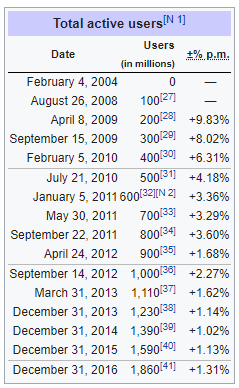
Kept following the Get Big Fast model, Facebook went for the mode similar to SixDegrees — it started to be open to the public, as anyone with a legit e-mail address could create a Facebook account. By opening to the public, Facebook was able to satisfy both intimate communication and public information exchange. Facebook users could always have an individual chat with others while being able to post things to the public. Also, with personal profiles, people would be able to personalize social connections and define their own communities. By August 26, 2008, Facebook had 100 million active users.

Filter Bubble
In the early stage of social media and search engine developments, information feed was random and inconsistent. People constantly received feeds that they did not
In the early 2000s, with relatively good hardware performance, researchers started to look for practical uses of machine learning algorithms. The possibility of personalized online content was introduced. Google, biggest search engine company, intended to use user data to predict user’s preferred information and to personalize results from the search. In 2006, Eric Schmidt, the CEO of Google, explicitly announced the next goal of Google search engine — personalized content. August 9, 2006, in press Q&A session, Eric stated that the ads display would be
Though personalized content display excludes unwanted information and spam out of the picture and makes individuals’ online experience more enjoyable, it is also rising a serious problem — the Filter Bubble. With an enclosed flow of information feed, people are having a hard time to reach out to the opinions and incidents outside the feed loop. Consequentially, individuals are fed with the same information and enjoying staying in the comfort zone. They essentially are trapped in the individualized bubble, and thus disconnected from the broader community. Such bubble will decrease individuals’ personal involvement in society involuntarily.
During Bill Clinton presidency, Clinton administration spotted the problem brought by technology — digital divide. By that, it means the information imbalance between people with computers and people without computers. Digital divide was an obvious problem and Clinton administration devoted and solved the problem eventually. However, the Filter Bubble is rather an underlying issue when individuals are enjoying it. Currently, no regulation has been issued to address the Filter Bubble, and it should be concerning to everyone.
End at 2:35
Filter Bubble is more about personal involvement in society, and it could easily cause more serious issues. Actually, we can consider the Filter Bubble as an enhancement tool for populism. It is possible that individuals are constantly receiving advantages of certain policy or incident while lack of awareness of downsides. Such information imbalance may keep individuals from making a rational decision for the best of their interests and make them vulnerable to manipulation. In the 2016 US presidential campaign, unprecedented issues were presented, fake news, prominence of populist rhetoric among candidates, and the essential role of social media played in support populist candidates. Even Trump admitted that he won the election because of Facebook and Twitter.
Entering the era of digital information, we need to be even more cautious about social media feeds while enjoying the benefits brought by those platforms.
References
White House Television (WHTV), “President Clinton’s Remarks on the Digital Divide,” Clinton Digital Library, accessed December 19, 2018, https://clinton.presidentiallibraries.us/items/show/16028.
“Early Dotcom Failures.” Zappos Case Study. Accessed December 19, 2018. http://www.ecommerce-digest.com/early-dot-com-failure-case-studies.html
“Computer Ownership Up Sharply in the 1990s.” Beyond the Numbers, March 01, 1999. https://www.bls.gov/opub/btn/archive/computer-ownership-up-sharply-in-the-1990s.pdf
“U.S.: Number of Households 1960-2017.” Statista. November 2017. Accessed December 19, 2018. https://www.statista.com/statistics/183635/number-of-households-in-the-us/.
“Percentage of U.S. Households with a Computer 1984-2010 | Survey.” Statista. February 2010. Accessed December 19, 2018. https://www.statista.com/statistics/184685/percentage-of-households-with-computer-in-the-united-states-since-1984/.
Calson, David. “CompuServe.” David Calson’s Virtual World. Accessed December 19, 2018. http://iml.jou.ufl.edu/carlson/history/compuserve.htm.
Hendricks, Drew. “Complete History of Social Media: Then And Now.” Small Business Trends. May 06, 2013. Accessed December 19, 2018. https://smallbiztrends.com/2013/05/the-complete-history-of-social-media-infographic.html.
Castells, Manuel. INFORMATIONALISM, NETWORKS, AND THE NETWORK SOCIETY: A THEORETICAL BLUEPRINT. BY MANUEL CASTELLS. Northampton, MA: Edward Elgar, 2004. 2004. Accessed December 19, 2018. https://annenberg.usc.edu/sites/default/files/2015/04/28/Informationalism, Networks and the Network Society.pdf.
“Search Engine Strategies Conference Q&A.” Google Search. August 09, 2006. Accessed December 19, 2018. https://www.google.com/press/podium/ses2006qa.html.
Clay Shirky, “How social media can make history,” filmed June 2009, TED video, 15:40, https://www.ted.com/talks/clay_shirky_how_cellphones_twitter_facebook_can_make_history/up-next
Eli Pariser, “Beware online ‘filter bubbles’,” filmed March 2011, TED video, 8:58, https://www.ted.com/talks/eli_pariser_beware_online_filter_bubbles?language=en#t-523470
Matthew Crain (2014) Financial markets and online advertising: reevaluatingthe dotcom investment bubble, Information, Communication & Society, 17:3, 371-384, DOI: 10.1080/1369118X.2013.869615
Jacob Groshek & Karolina Koc-Michalska (2017) Helping populism
win? Social media use, filter bubbles, and support for populist presidential candidates in the 2016 US election campaign, Information, Communication & Society, 20:9, 1389-1407, DOI: 10.1080/1369118X.2017.1329334
