José Rafael Aragón & Artistas del Taller No Registrados (1795-1862)
El Reredos de la Capilla de Talpa
C. 1838 – 1851
Gesso, Témpera, y Pino
115 x 71 pulgadas (292.1 x 180.3 cm)
Colección de FAC, TM 3906
José Rafael Aragón & Unrecorded Workshop Artists (1795 – 1862)
Talpa Chapel Altar Screen
c. 1838 – 1851
Gesso, tempera on pine
115 x 71 in. (292.1 x 180.3 cm)
Museum Purchase Fund, Fine Arts Center, TM 3906
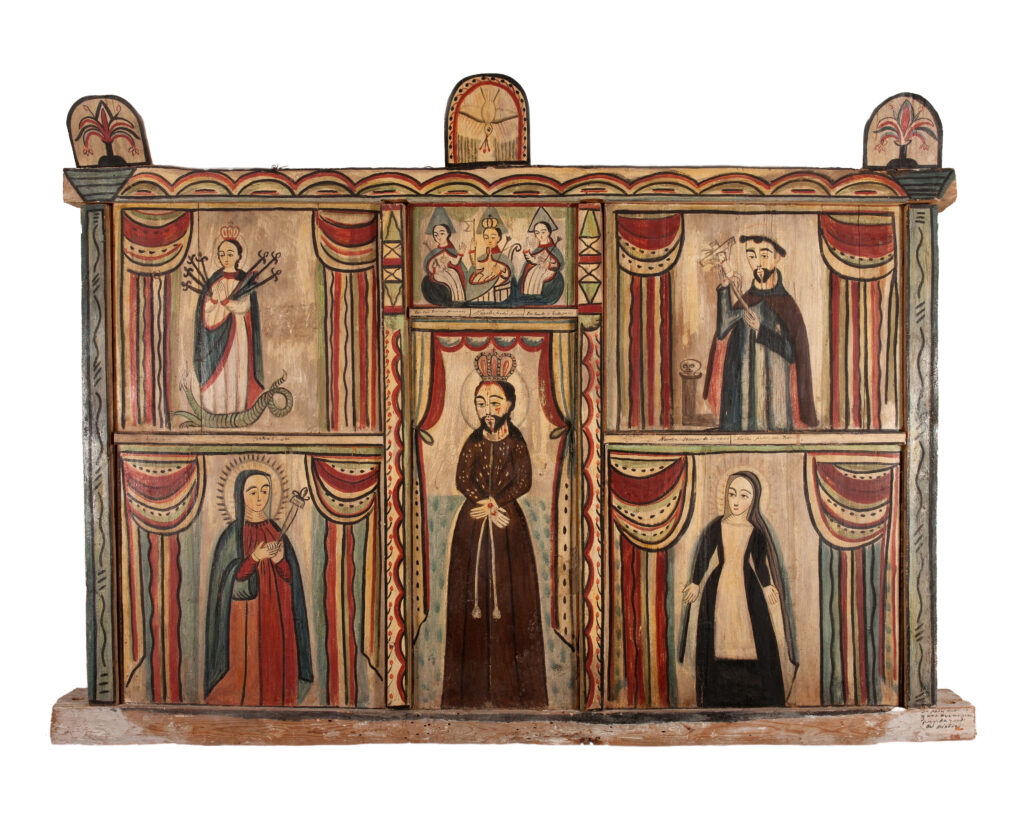
Las figuras religiosas detalladas, representadas con devoción, en el reredos de la Capilla de Talpa (ca. 1838 – 1851) están compuestas por tonos joya vívidos. Con un patrón decorativo festoneado alrededor de los bordes de las representaciones pictóricas de figuras religiosas como Jesús y la Santísima Trinidad, el artista José Rafael Aragón (ca. 1795 – 1862) creó una obra de escala monumental para ser un pilar fundamental de la Capilla de Nuestra Señora de Talpa.
El reredos crea una imagen devocional con tres profundidades espaciales distintas. Primeramente, los elementos escultóricos del marco decorativo circundante y los pilares verticales encierran a Jesús, la figura central, en una caja decorativa. Esto le da a la estructura un primer plano—o un elemento más cercano al espectador.
En el fondo del plano espacial, unas formas estampadas enmarcan cada caja. Sin embargo, los dos tipos de espacio—el estructural y el decorativo—están claramente separados por la superposición; los elementos que son como pilares cubren algunos pequeños elementos de las figuras subsecuentes. El plano espacial más profundo exhibe los propios personajes; existen en un punto intermedio entre los patrones decorativos que distinguen a los iconos religiosos del fondo simplificado.
Con líneas oscuras y gráficas, Aragón utiliza pinceladas sólidas y fuertes para caracterizar los personajes y su entorno. Las líneas oscuras delinean las formas y aportan detalles como el punteado en los drapeados; estos elementos fuertes delinean las formas y ayudan a crear contraste entre los diversos elementos espaciales y figurativos, culminando en la claridad de la composición de Aragón.
Además, la manipulación del color y la luz eleva la calidad del detalle, especialmente la de las figuras. Los colores contrastan por medio de los fondos sencillos y lisos y por medio de las cortinas rojo rubí, blanco y azul pálido. Los estampados condensados alrededor de las figuras contrastan significativamente con el fondo blanco que enmarca a las personas en un vacío. En cambio, el estampado enfatiza los detalles delicados y la importancia de las figuras, con sus vestimentas y adornos simbólicos. La luz, por medio de aureolas, llama atención hacia las figuras y les confiere un significado iconográfico; esto las denota como personas altamente religiosas y glorificadas. Los halos se manifiestan en forma de pinceladas moteadas o de oro en un círculo que rodea la cabeza de cada una de estas figuras; los halos confieren piedad y religiosidad a cada uno de estos iconos detallados.
Por último, con la división pictórica a lo largo del plano visual, Aragón rompe la simetría bilateral—la estructura simétrica—de la composición en tercios verticales. Cada uno de estos tercios se vuelve a dividir en dos segmentos horizontales. En las secciones de los extremos izquierdo y derecho, estas divisiones dividen los tercios por la mitad horizontalmente. En el tercio central, el cuarto superior de este tercio se separa con una línea horizontal, lo que crea una sección rectangular más grande en la parte inferior de este tercio. Por lo tanto, la posición más central de todo el reredos muestra a Jesús con una corona, un halo, y la cabeza y las manos heridas.
A lo largo del borde superior del reredos, tres semicírculos que se extienden verticalmente sostienen dos símbolos diferentes. Posicionados equidistantemente, el semicírculo central sostiene la paloma, en representación del Espíritu Santo o la paz, y los semicírculos de los extremos izquierdo y derecho presentan la flor de lis, un símbolo cristiano de la Virgen María y la Santísima Trinidad. Además, el patrón de tres se encuentra diversas veces en toda la obra, con las tres figuras sobre la cabeza de Jesús, los tres arcos en la parte superior del reredos y las tres secciones verticales. La repetición de tres refuerza la religiosidad y la espiritualidad de la obra, lo cual probablemente afirma la importancia de la Santísima Trinidad.
En resumen, la reredos de la Capilla de Talpa de José Rafael Aragón es una síntesis magistral del espacio, color y simbolismo que eleva su narrativa religiosa por medio de elecciones intencionales sobre la composición de la obra. Los planos espaciales tridimensionales, las líneas gráficas fuertes y el uso estratégico de la luz y el color atraen la mirada del espectador hacia las figuras religiosas centrales, particularmente Jesús, cuya importancia simbólica se refuerza a través del halo y la corona. La organización cuidadosa del espacio que Aragón logró, desde el marco complejo del primer plano, hasta los iconos religiosos del plano medio, demuestra una posible división entre lo divino y lo ornamental. Con el espacio multicapa, las separaciones verticales y horizontales, y los elementos decorativos, las figuras retroceden hacia un espacio vacío, lo que crea distancia entre la figura y el espectador. La simetría bilateral sutil de la composición, con sus secciones que fueron cuidadosamente divididas, resalta la centralidad de Cristo. Esto une todo el reredos tanto espacial como temáticamente, pero Cristo no es la figura más cercana al espectador; está velado y oscurecido por los patrones decorativos. En cambio, las capas múltiples crean una separación tanto visual como espacial que simboliza su distancia del mundo humano, ya que el espectador está alejado del entorno inmediato de Cristo. Este distanciamiento entre Cristo y el espectador sirve no sólo como un reflejo de la trascendencia divina, sino también como un recordatorio conmovedor de la distancia entre lo sagrado y lo terrenal. Esto urge al espectador a reflexionar sobre la importancia y distancia de lo que es divino y también la necesidad de la mediación por medio de la fe, el arte, y la devoción. En definitiva, la obra de Aragón logra transmitir expresión espiritual y grandeza artística; crea un reredos dinámico que invita tanto a la reverencia como a la admiración.
La integración cuidadosa de la iconografía simbólica que Aragón implementa engrandece la narrativa espiritual; esto fortalece la estructura espacial y compositiva del reredos de la Capilla de Talpa. A través de la colocación meticulosa de símbolos religiosos como el halo, la paloma y la flor de lis, el reredos destaca su mensaje devocional, y guía la interpretación del espectador de las figuras divinas y sus roles sagrados. La iconografía—los símbolos y significados—presente en el reredos de la Capilla de Talpa es rica en simbolismo teológico y penitencial; se inspira en la tradición cristiana inmensa para expresar tanto la trascendencia divina como el sufrimiento humano.
En la parte superior central, el Espíritu Santo, representado como una paloma, ocupa un papel universal y esencial en la iconografía cristiana. La imagen del Espíritu Santo descendiendo como una paloma tiene sus orígenes tiene sus orígenes en el Nuevo Testamento, particularmente en el relato del bautismo de Cristo, en el cual “el descenso del Espíritu de Dios como una paloma” señala la aprobación y presencia divina (Mateo 3:16). En este contexto, la paloma sirve como un símbolo de la pureza y paz, así como un vínculo directo entre lo divino y la humanidad. Ubicada en la parte superior del reredos, la paloma representa una bendición desde arriba, la cual difunde su influencia santificadora en la capilla y la comparte con todos las personas que se reúnen allí. Esta imagen trascendente del Espíritu Santo refuerza el concepto de la intervención divina y de gracia; este concepto permea el espacio y fortalece el culto.
En la parte superior izquierda, Nuestra Señora de la Purísima Concepción, presenta otro nivel de significado teológico. Esta imagen tiene orígenes antiguos; proviene de las representaciones de la mujer que está vestida del sol y coronada con doce estrellas en el Libro de las Revelaciones (Revelaciones 12:1-5). A principios del siglo XVI, esta representación pasó a tener el título mariano específico de la Inmaculada Concepción. La imagen de la Virgen María en este contexto destaca su naturaleza pura; concibió sin cometer el pecado original, lo cual es un dogma enfatizado por los Franciscanos. Su asociación con la serpiente o el dragón a sus pies—una referencia a Revelaciones 12—simboliza su victoria sobre el mal, reforzando su pureza y favor divino. En el Nuevo Mundo, particularmente en el Nuevo México colonial, la devoción a Nuestra Señora de la Inmaculada Concepción fue propagada con fervor por los franciscanos, quienes la consideraban patrona de su orden. Su importancia en el reredos, junto con su representación penitencial en este caso, aporta una conexión terrenal a su pureza, que de otra manera, apenas sería trascendente. Esto enfatiza su papel en el sufrimiento y la penitencia de los fieles.
En el centro de la parte superior del reredos, se ubica La Santísima Trinidad representando el pináculo de la doctrina cristiana; representa visualmente el misterio teológico del Dios Trino. La Trinidad encapsula la plenutid de la divinidad: Dios Padre, Dios Hijo y el Espíritu Santo, cada uno distinto pero unido. Esta imagen trascendente de la Deidad encarna la unión suprema del Ser y la Divinidad. Tradicionalmente, las representaciones de la Trinidad frecuentemente representan a tres jóvenes idénticos, una referencia a la visión bíblica del encuentro de Abrahán con tres visitantes divinos. En el caso de la Capilla de Talpa, el personaje en el centro es identificable como Dios Padre, coronado y vestido con ropas regias, las cuales simbolizan Su autoridad suprema y presencia divina. La iconografía de la Trinidad hace referencia al concepto cristiano de Dios como una unidad de personas diversas pero complementarias, cada una integral a la misión divina de la salvación.
La imagen de San Francisco de Asís ubicada en el panel superior derecho, cumple la función fundamental de expresar los valores penitenciales que caracterizan a la capilla. San Francisco, el fundador de la Orden Franciscana, se representa con los estigmas, las marcas visibles de la Pasión de Cristo, que simbolizan su profunda identificación con el sufrimiento de Cristo. Su presencia en el reredos es significativa, no sólo por su papel en la creación de las instituciones religiosas de Nuevo México, sino también por su centralidad en las prácticas penitenciales de la región. Su postura es meditativa; carga un crucifijo y está posicionado junto a un cráneo humano. Su postura refleja su devoción al sufrimiento de Cristo y la naturaleza transitoria de la vida humana. La imagen de San Francisco se convierte en un símbolo poderoso de la penitencia y humildad, y encarna el compromiso franciscano de vivir una vida de oración e imitación de Cristo.
Pasando a la parte inferior, Nuestra Señora de los Dolores y Nuestra Señora de la Soledad representan imágenes marianas profundamente conectadas a la Pasión de Cristo. Estas imágenes retratan la participación dolorosa de María en el sufrimiento de Cristo, y cada una de ellas sirve como una poderosa reflexión sobre el duelo y la penitencia. La representación de Nuestra Señora de los Dolores frecuentemente la muestra con una espada atravesándole el corazón; simboliza la profecía de Simeón en Lucas 2:35, que predice el dolor que María sufriría como la madre del Cristo crucificado. Esta imagen se hizo popular, particularmente a finales de la Edad Media, y sirve como una forma de centrar el sufrimiento de María de manera devocional, ofreciéndoles a los fieles un camino para comprender el costo de la redención. En cambio, Nuestra Señora de la Soledad representa a María con su vestido de luto de una monja, enfatizando su duelo silencioso y contemplativo después de la muerte de su Hijo. Esta devoción en particular, que es más común en el catolicismo español, refleja un sufrimiento personal y silencioso que tiene sus orígenes en el período del Renacimiento. Ambas imágenes marianas en el reredos destacan los temas del duelo, la soledad y la penitencia, e invitan al espectador a entrar en la lucha emocional y espiritual que sigue después de la Pasión.
Por último, Jesús Nazareno ocupa un papel central como el patrón de la Hermandad Penitente, encarnando el símbolo máximo del sufrimiento y la redención. La imagen de Cristo como el Varón de dolores es un tema perdurable en el arte cristiano, lo que enfatiza su sufrimiento eterno por los pecados de la humanidad. Esta representación de Jesús, frecuentemente caracterizada por la corona y sus vestiduras regias, destaca tanto su realeza divina como su papel de un siervo que está sufriendo. La Hermandad Penitente, dedicada a actos de penitencia, encontró en la imagen de Jesús Nazareno un modelo para su propia devoción, con procesiones y rituales que recrean las fases de la Pasión de Cristo. La inclusión de esta imagen en el reredos conecta la capilla aún más con las prácticas penitenciales de Nuevo México, donde dicha devoción era una fuerza poderosa tanto en la vida religiosa individual como en la vida religiosa comunitaria.
Toda la imaginería del reredos de la Capilla de Talpa forma una convergencia rica de iconografía cristiana; mezcla representaciones trascendentes de figuras divinas con representaciones profundamente penitenciales del sufrimiento humano. Estas imágenes sirven como afirmaciones teológicas y llamadas a la reflexión espiritual; ofrecen a los devotos una visión de lo divino y un camino hacia la penitencia personal y comunitaria. Aragón retrata imágenes iconográficas que tienen orígen en prácticas históricas del catolicismo y el cristianismo. Sus referencias al dogma cristiano vinculan su estilo artístico y su simbolismo a un pasado profundamente referencial.
Además, la inclusión intencional de las obras de Aragón en el canon histórico del arte ayuda a crear una conciencia compleja de las contribuciones artísticas y estilísticas que el reredos ha aportado. La conexión entre la representación de Jesús en el reredos de la Capilla de Talpa y Guernica de Picasso (1937) implica un diálogo entre el simbolismo religioso, la abstracción y la intensidad emocional, a pesar de las diferencias marcantes en el tiempo, estilo y contexto entre estas dos obras. Ambas obras exploran los temas del sufrimiento, la trascendencia y la condición humana, aunque a través de medios muy diferentes: una profundamente arraigada en la iconografía católica, y la otra un grito modernista contra la devastación creada por la guerra. Sin embargo, varios elementos que ambas obras tienen las unen en términos de su intensidad, abstracción, y capacidad de evocar respuestas emocionales profundas en sus audiencias.
La representación de Nuestro Padre Jesús Nazareno, la figura principal, en el Reredos de la Capilla de Talpa y la figura central de Guernica comparten una intensidad profunda por su impacto emocional, particularmente a través de la simplificación de sus formas para poder transmitir un sufrimiento profundo. En el reredos, Jesús se representa como el “Varón de dolores”: una representación de su Pasión que encarna el sufrimiento humano y el sacrificio divino. Su postura, marcada por imágenes tanto regias como dolorosas, se centra en el peso emocional del sacrificio de Cristo. Las formas simplificadas (con gran énfasis en el sufrimiento, la corona, y las heridas) son símbolos directos y conmovedores que comunican la profundidad del dolor humano y la intervención divina en un lenguaje visual accesible e inmediato. De manera similar, Guernica de Picasso, aunque abstracto y fragmentado, representa la angustia y la devastación de la guerra con formas crudas y simbólicas. Las figuras humanas y los animales en la pintura están representados con rasgos simplificados y distorsionados; la obra se centra no en la representación naturalista sino en la expresión emocional. El sufrimiento de las víctimas se muestra a través de formas fracturadas y angulares, lo cual evoca dolor tanto físico como psicológico. De manera parecida a la representación de Jesús en el reredos, Guernica utiliza la abstracción y la simplificación para transmitir la fuerza primordial del sufrimiento; expresa el duelo y el trauma universales a través de un lenguaje visual que trasciende circunstancias específicas.
Además, ambas obras recurren a la abstracción para enfatizar su centro espiritual o emocional. El reredos de la Capilla de Talpa depende en gran medida de la iconografía religiosa: figuras como el Espíritu Santo y la Inmaculada Concepción se presentan en formas estilizadas e icónicas que priorizan el significado simbólico sobre el naturalismo. Jesús Nazareno es igualmente abstracto, centrándose en los elementos clave de la Pasión—la corona y las heridas—para expresar la trascendencia espiritual y el sufrimiento humano. La simplificación del modelado y la perspectiva dirige la atención del espectador hacia el contenido emocional de la imagen en lugar del realismo físico, o el naturalismo, de la figura. De manera comparable, Guernica de Picasso simplifica la forma humana de manera radical. Las figuras ya no se presentan como representaciones realistas, sino que se dividen en formas geométricas y angulares. La composición fracturada de Picasso y la falta de un modelado tradicional o de profundidad en las figuras crean una imagen que obliga al espectador a interactuar directamente con la intensidad emocional de la escena, el lugar de cualquier ilusión de un espacio tridimensional. Al igual que el reredos, Guernica utiliza una forma de abstracción para profundizar la conexión emocional con el espectador; se centran en las experiencias espirituales y emocionales de las figuras, en lugar de su semejanza física.
Tanto el reredos de la Capilla de Talpa como Guernica reflejan una fusión de tradiciones: una enraizada en la iconografía cristiana antigua y la otra en formas modernas y abstractas. El reredos se inspira en tradiciones cristianas antiguas de la iconografía, pero también simplifica y sintetiza estos símbolos en expresiones más directas del misterio divino y del sufrimiento humano. El interés de Picasso por la escultura ibérica y el primitivismo durante sus primeros años también lo llevó a adoptar una forma de abstracción que revivió fuentes antiguas y no occidentales, fusionando estas influencias con las tradiciones artísticas occidentales. De manera similar, ambas obras representan una convergencia entre el pasado y el presente, reformulando símbolos familiares para expresar nuevas realidades emocionales e ideológicas. Aunque el reredos de la Capilla de Talpa y Guernica surgen de contextos culturales, históricos, y artísticos muy diferentes, están conectados por su capacidad de evocar respuestas emocionales profundas a través de la simplificación y abstracción de las formas. Ambas obras abordan los temas profundos del sufrimiento, el sacrificio, y la trascendencia espiritual. Utilizan la abstracción no sólo como un estilo artístico, sino como una forma para intensificar el compromiso emocional y espiritual. A través de sus iconografías respectivas y formas abstractas, Picasso y Aragón involucran al espectador en una conversación universal sobre las profundidades del sufrimiento humano, las dimensiones espirituales y emocionales de ese sufrimiento, y la posibilidad de redención o de resistencia que conlleva. En conclusión, el reredos de la Capilla de Talpa de José Rafael Aragón ejemplifica el cruce poderoso entre la iconografía sagrada, la composición espacial, y la profundidad emocional. A través de su uso complejo del color, la forma y la luz, Aragón crea una narrativa visualmente cautivante que habla de la naturaleza trascendente de lo divino y al mismo tiempo resalta las prácticas penitenciales y devocionales de los devotos. La organización meticulosa de las figuras, los símbolos y los elementos decorativos del reredos refuerza los mensajes teológicos del cristianismo e invita a los espectadores a reflexionar sobre la distancia entre lo sagrado y lo terrenal. La obra de Aragón es rica en simbolismo teológico y artesanía artística. Sirve como una invitación a la reverencia y también como un llamado a la reflexión espiritual. Al crear conexiones entre este reredos y otras obras de arte, como Guernica de Picasso, queda claro que la abstracción y la representación simbólica son herramientas poderosas para transmitir las verdades emocionales y espirituales profundas de la experiencia humana. Por último, el reredos de la Capilla de Talpa representa la capacidad del arte de unir lo sagrado y lo secular; ofrece una meditación conmovedora sobre el sufrimiento, la fe y la redención.
Vivid jewel tones comprise the detailed religious figures devoutly depicted in the Talpa Chapel altar screen (ca. 1838 – 1851). With scalloped decorative patterning around the edges of the pictorial representations of religious figures like Jesus and the Holy Trinity, the artist, José Rafael Aragón (ca. 1795 – 1862), created a monumentally scaled work as the cornerstone of the Chapel of Our Lady of Talpa.
The altarpiece creates a devotional vision with three separate spatial depths. Firstly, the sculptural elements of the surrounding decorative frame and vertical pillars encase Jesus, the central figure, in a decorative box, providing the structure with a foreground or element closest to the viewer. Receding into the spatial plane, patterned shapes frame each box. Yet, the two layers of space, structural and decorative, are clearly separated by overlapping; the pillar-like segments cover small elements of the subsequent figures. The deepest spatial plane, showcases the figures themselves, existing in a middle ground between the decorative patterning distinguishing the religious icons and the simplified background.
With dark, graphic lines, Aragón uses bold, solid paint strokes to characterize the figures and their surrounding environs. The dark lines outline shapes and provide details like stippling in the drapery; these bold elements delineate the shapes and help create contrast between the various spatial and figural elements culminating in clarity within Aragón’s composition.
Additionally, manipulations of color and light continue to heighten the qualities of detail, particularly concerning the figures. The colors contrast through simplified, blank backgrounds and the ruby red, white, and pale blue curtains. The condensed patterns surrounding the figures contrast significantly with the white background encasing the people in a void; in turn, the patterning emphasizes the delicate detail and importance of the figures with their symbolic attire and embellishments. Continuing to draw attention to the figures, light through halos, imbues the figures with iconographical significance, denoting them as highly religious and glorified individuals. Taking the form of flecked brushstrokes or gold in a circle framing the head of each of these figures, the halos endow piety and religiosity to each of these detailed icons.
Finally, with the pictorial segmentation throughout the visual plane, Aragón breaks the bilateral symmetry, or symmetrical structure, of the composition into vertical thirds. Each of these thirds is broken again into two segments horizontally. For the left and rightmost sections, these breaks divide the thirds in half horizontally. For the central third, the upper fourth of the column is separated with a horizontal bar, creating a larger rectangular portion at the bottom of the column. Thus, the central-most position of the entire altar screen showcases Jesus with a crown, halo, and wounded head and hands.
Along the top edge of the altar screen, three semi-circles extending vertically hold two different symbols. Equidistantly positioned, the central semi-circle holds the dove representing the Holy Spirit or peace, and the left and rightmost semi-circles feature the fleur-de-lis, a Christian symbol of the Virgin Mary and the Holy Trinity. Furthermore, the pattern of threes finds several resonances throughout this piece, with the three figures above Jesus’ head, three arches at the top of the altarpiece, and three vertical sections. Likely echoing the importance of the Holy Trinity, the repetition of threes reinforces the religiosity and spirituality within the piece.
In sum, José Rafael Aragón’s Talpa Chapel altar screen is a masterful synthesis of space, color, and symbolism that elevates its religious narrative through deliberate compositional choices. The three-dimensional spatial planes, bold graphic lines, and strategic use of light and color draw the viewer’s eye toward the central religious figures, particularly Jesus, whose symbolic significance is reinforced through the halo and crown. Aragón’s careful organization of space, from the foreground’s intricate frame to the middle ground’s religious icons, reflects a potential separation between the divine and the ornamental. With the multilayered space, vertical and horizontal separations, along with decorative elements, the figures recess into a void-like space manufacturing distance from the viewer. The subtle bilateral symmetry of the composition, with its carefully divided sections, highlights the centrality of Christ, anchoring the entire altarpiece both spatially and thematically, yet Christ is not closest to the viewer, he is veiled and obscured by the decorative patterning. In turn, the many layers create visual and spatial separation symbolic of his distance to the human world, for the audience is removed from Christ’s immediate surroundings. This distancing serves not only as a reflection of divine transcendence but also as a poignant reminder of the gap between the sacred and the earthly, urging the viewer to reflect on the importance and distance of the divine and the need for mediation through faith, art, and devotion. Ultimately, Aragón’s work achieves spiritual expression and artistic grandeur, creating a dynamic altarpiece that invites both reverence and admiration.
Building upon the spatial and compositional structure of the Talpa Chapel Altar Screen, Aragón’s careful integration of symbolic iconography further enhances the spiritual narrative. Through the meticulous placement of religious symbols such as the halo, the dove, and the fleur-de-lis, the altarpiece underscores its devotional message, guiding the viewer’s understanding of the divine figures and their sacred roles. The iconography, or symbols and meanings, present on the altar screen of the Talpa Chapel is rich with theological and penitential symbolism, drawing from a deep well of Christian tradition to convey both divine transcendence and human suffering.
At the top center, the Holy Ghost, represented as a Dove, occupies a universal and essential role in Christian iconography. The image of the Holy Spirit descending as a dove is rooted in the New Testament, particularly in the account of Christ’s baptism where “the Spirit of God descending as a dove” signals divine approval and presence (Matthew 3:16). In this context, the dove serves as a symbol of purity and peace, as well as a direct link between the divine and humanity. Positioned at the top of the altar screen, the dove embodies a blessing from above, extending its sanctifying influence upon the chapel and all who gather within. This transcendent image of the Holy Spirit reinforces the notion of divine intervention and grace, which permeates the space and elevates the act of worship.
To the top left, Our Lady of the Immaculate Conception offers another layer of theological significance. This image has ancient roots, tracing back to depictions of the woman described in the Book of Revelation, who is clothed with the sun and crowned with twelve stars (Revelation 12:1-5). By the early 16th century, this representation evolved into the specific Marian title of the Immaculate Conception. The image of the Virgin Mary in this context underscores her sinless nature, conceived without original sin, a dogma emphasized by the Franciscans. Her association with the serpent or dragon at her feet, a reference to Revelation 12, symbolizes her victory over evil, reinforcing her purity and divine favor. In the New World, particularly in colonial New Mexico, devotion to Our Lady of the Immaculate Conception was fervently propagated by the Franciscans, who regarded her as a patroness of their order. Her prominence on the altar screen, alongside her penitential portrayal in this instance, brings an earthly connection to her otherwise transcendent purity, emphasizing her role in the suffering and penitence of the faithful.
At the center of the top row of the altar screen, the Holy Trinity stands as a pinnacle of Christian doctrine, visually representing the theological mystery of the Three-in-One God. The Trinity encapsulates the fullness of divinity – God the Father, God the Son, and the Holy Spirit – each distinct but united. This transcendent image of the Godhead embodies the ultimate union of Being and Divinity. Traditionally, representations of the Trinity often depict three identical young men, a reference to the biblical vision of Abraham’s encounter with three divine visitors. In the case of the Talpa Chapel, the figure in the center is identifiable as God the Father, crowned and robed in regal attire, symbolizing His supreme authority and divine presence. The iconography of the Trinity speaks to the Christian understanding of God as a unity of diverse but complementary persons, each integral to the divine mission of salvation.
The image of St. Francis of Assisi positioned on the upper right-hand panel, serves a critical function in conveying the penitential ethos that characterizes the chapel. St. Francis, founder of the Franciscan Order, is depicted with the stigmata, the visible marks of Christ’s Passion, symbolizing his deep identification with the suffering Christ. His inclusion on the altar screen is significant, not only due to his role in founding the religious institutions of New Mexico but also because of his centrality to the penitential practices of the region. His meditative stance, holding a crucifix and positioned with a human skull, reflects his devotion to Christ’s suffering and the transient nature of human life. The image of St. Francis becomes a powerful symbol of penance and humility, embodying the Franciscan commitment to living a life of prayer and imitation of Christ.
Moving to the lower rows, to Nuestra Señora de los Dolores, Our Lady of Sorrows, and Nuestra Señora de la Soledad, Our Lady of Solitude, represent Marian images deeply tied to the Passion of Christ. These images reflect Mary’s sorrowful participation in Christ’s suffering, each serving as a powerful meditation on grief and penance. The portrayal of Our Lady of Sorrows often shows her with a sword piercing her heart, symbolizing the prophecy of Simeon in Luke 2:35, foretelling the pain Mary would endure as the mother of the crucified Christ. This image became particularly popular in the later Middle Ages and serves as a devotional focus on the suffering of Mary, offering the faithful a path to understand the cost of redemption. In contrast, Our Lady of Solitude depicts Mary in the mourning attire of a nun, emphasizing her quiet, contemplative grief after the death of her Son. This particular devotion, more common in Spanish Catholicism, reflects a personal, silent suffering rooted in the Renaissance period. Both Marian images on the altar screen underscore themes of sorrow, solitude, and penitence, inviting the viewer to enter into the emotional and spiritual struggle that accompanies the Passion.
Finally, Jesus Nazarene occupies a central role as the patron of the Penitente Brotherhood, embodying the ultimate symbol of suffering and redemption. The image of Christ as the Man of Sorrows is an enduring motif in Christian art, emphasizing his eternal suffering for humanity’s sins. This portrayal of Jesus, often marked by a crown and regal garments, underscores both his divine kingship and his role as the suffering servant. The Penitente Brotherhood, dedicated to acts of penance, found in the image of Jesus Nazarene a model for their own devotion, with processions and rituals that reenact the stages of Christ’s Passion. The altar screen’s inclusion of this image further connects the chapel to the penitential practices of New Mexico, where such devotion was a powerful force in both personal and communal religious life.
Together, the imagery on the Talpa Chapel’s altar screen forms a rich convergence of Christian iconography, blending transcendent depictions of divine figures with deeply penitential representations of human suffering. These images serve as both theological affirmations and calls to spiritual reflection, offering the faithful both a glimpse of the divine and a path toward personal and communal penitence. Depicting iconographic imagery rooted in historic practices of Catholicism and Christianity, Aragón’s references to Christian dogma links his style and symbolism to a deeply referential past.
Further, intentionally linking Aragón’s works to the art historical canon helps provide a complex understanding of the altar screen’s artistic and stylistic contributions. The connection between the depiction of Jesus on the Talpa Chapel altar screen and Picasso’s Guernica (1937) involves a dialogue between religious symbolism, abstraction, and emotional intensity, despite the stark differences in time, style, and context. Both works explore themes of suffering, transcendence, and the human condition, albeit through very different means – one deeply rooted in Catholic iconography, the other a modernist cry against the devastation of war. However, several shared elements unite the two works in terms of their intensity, abstraction, and their ability to evoke profound emotional responses from their audiences.
The depiction of Jesus Nazarene, the primary figure, on the Talpa Chapel’s Altar Screen and the central figure of Guernica share a profound intensity in their emotional impact, particularly through the simplification of forms to convey deep suffering. In the altar screen, Jesus is presented as the “Man of Sorrows,” a representation of his Passion, embodying human suffering and divine sacrifice. His posture, marked by both regal and painful imagery, focuses on the emotional weight of Christ’s sacrifice. The simplified forms – heavy emphasis on suffering, crown, and wounds – are direct and poignant symbols, communicating the depth of human pain and divine intervention in a visual language that is accessible and immediate. In a similar vein, Picasso’s Guernica, though abstract and fragmented, depicts the anguish and devastation of war in stark, symbolic forms. The human figures and animals in the painting are rendered with simplified, distorted features, focusing not on naturalistic representation but on emotional expression. The suffering of the victims is shown through fractured and angular forms, evoking both physical and psychological pain. Like the altar screen’s depiction of Jesus, Guernica uses abstraction and simplification to convey the primal force of suffering, translating universal grief and trauma into a visual language that transcends specific circumstances.
Additionally, both pieces engage in abstraction to emphasize their spiritual or emotional core. The Talpa Chapel altar screen relies heavily on religious iconography – figures like the Holy Spirit and the Immaculate Conception are presented in stylized, iconic forms that prioritize symbolic significance over naturalistic detail. Jesus Nazarene is similarly abstracted, focusing on key elements of the Passion, the crown and wounds, to communicate spiritual transcendence and human suffering. The reduction of modeling and perspective directs the viewer’s attention to the emotional content of the image rather than the physical realism, or naturalism, of the figure. In a comparable way, Picasso’s Guernica radically simplifies the human form. Figures are no longer presented as realistic representations but are broken into geometric, angular shapes. Picasso’s fractured composition and lack of traditional modeling or depth in the figures create an image that forces the viewer to engage directly with the emotional intensity of the scene, rather than any illusion of three-dimensional space. Much like the altar screen, Guernica uses a form of abstraction to deepen the emotional connection with the viewer, focusing on the spiritual and emotional experiences of the figures rather than their physical likeness.
Both the Talpa Chapel altar screen and Guernica reflect a merging of traditions—one rooted in ancient Christian iconography and the other in modern, abstract forms. The altar screen draws upon long-standing Christian traditions of iconography, but it also simplifies and distills these symbols into more direct expressions of divine mystery and human suffering. Picasso’s interest in Iberian sculpture and primitivism during his early years also led him to embrace a form of abstraction that revived ancient and non-Western sources, merging these influences with Western artistic traditions. In a similar manner, both works represent a convergence of the past and present, reshaping familiar symbols to express new emotional and ideological realities. While the Talpa Chapel Altar Screen and Guernica emerge from vastly different cultural, historical, and artistic contexts, they are united by their ability to evoke deep emotional responses through the simplification and abstraction of form. Both works address profound themes of suffering, sacrifice, and spiritual transcendence, using abstraction not only as a stylistic choice, but as a means of intensifying emotional and spiritual engagement. Picasso and Aragón, through their respective iconographies and abstracted forms, engage the viewer in a universal conversation about the depths of human suffering, the spiritual and emotional dimensions of that suffering, and the redemptive or defiant potential it carries.
In conclusion, the Talpa Chapel altar screen by José Rafael Aragón exemplifies the powerful intersection of sacred iconography, spatial composition, and emotional depth. Through its intricate use of color, form, and light, Aragón creates a visually compelling narrative that speaks to the transcendent nature of the divine while highlighting the penitential and devotional practices of the faithful. The altarpiece’s meticulous arrangement of figures, symbols, and decorative elements reinforces the theological messages of Christianity and invites viewers to reflect on the distance between the sacred and the earthly realm. Aragón’s work, rich in theological symbolism and artistic craftsmanship, serves as both an invitation to reverence and a call to spiritual contemplation. By drawing connections between this altarpiece and other works of art, such as Picasso’s Guernica, it becomes clear that abstraction and symbolic representation are powerful tools in conveying the deep emotional and spiritual truths of the human experience. Ultimately, the Talpa Chapel altar screen stands as a timeless testament to the ability of art to bridge the sacred and the secular, offering a poignant meditation on suffering, faith, and redemption.
Este texto fue escrito por Sadie Burge (CC ’25).
This piece was written by Sadie Burge (CC ’25).