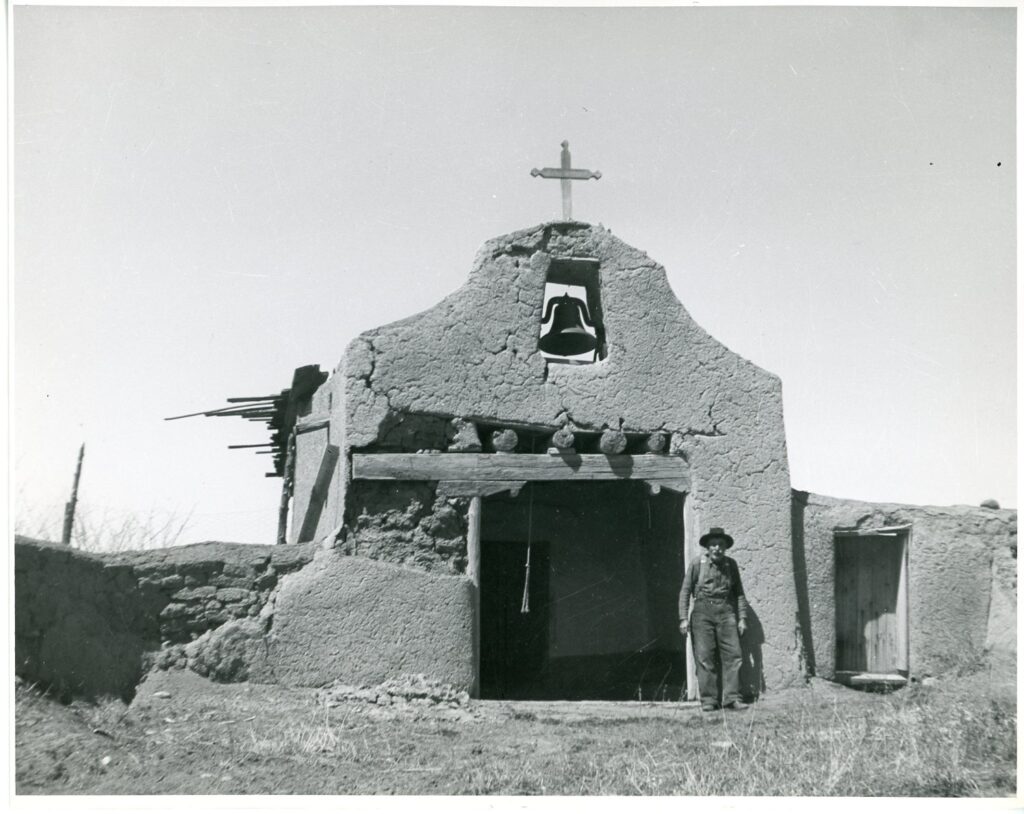
La capilla de la familia Durán fue construida por Nicolás Sandoval entre 1838 y 1851. Sandoval, nacido aproximadamente en 1797, hijo de Antonio Matías Sandoval y María Ignacia Bueno, creció en la región de Santa Cruz. Sus padres fueron registrados como vecinos, lo que significa que sus antepasados eran españoles. Después de vivir probablemente como aldeanos en las montañas de Las Truchas, se mudaron hacia el norte con la esperanza de encontrar terrenos baratos y cultivables. Sandoval, junto con por lo menos otros cuatro hermanos, creció en la región Ranchos de Taos.
De adulto, Nicolás Sandoval se casó con María Ignacia Martínez y empezó a buscar más terreno para criar a su familia. En esa época, muchas personas se estaban asentando en Taos, y los recursos eran cada vez más escasos. Sandoval pidió que el gobierno local le diera una parcela de terreno apartada de las demás personas, donde planeaba construir una capilla. El gobierno de Taos denegó su pedido. En cambio, él construyó una capilla a un lado de su casa actual. La dedicó a Nuestra Señora de Talpa, llamada así por una aparición milagrosa de María en Talpa, México. El oratorio (la capilla) se volvió un lugar de culto no solamente para la familia, sino para toda la comunidad.
En la época que se construyó la capilla, Sandoval tenía dos hijas: Paula (Pablita) y Juana María. Pablita, la cabeza de la familia no oficial, heredó la capilla después de la muerte de Sandoval en 1872. Juana María se casó con José Francisco de la familia Durán. Como los Sandoval, los Durán habían vivido en Nuevo México por generaciones. El abuelo de José, Don Ignacio Durán, fue el patrocinador principal de la Iglesia de San Francisco en Ranchos de Taos. Ambas familias compartieron la capilla, y los santos que había en su interior, durante generaciones por venir.
En 1872, Leandro Durán nació, hijo de Mauricio Durán y Romalda Tafoya. Fue criado por su tía abuela Pablita y creció en el fervor de la vida religiosa que giraba en torno a la capilla. Las mujeres encendían velas para orar cada mañana. La comunidad celebraba bautizos, velorios, y santos dentro y alrededor del edificio. La capilla también servía de morada (un espacio de reuniones) para la Fraternidad Penitente, la secta neomexicana de catolicismo que Sandoval había ayudado a liderar.
Sin embargo, en los años 1940s, tanto Leandro como la capilla estaban envejeciendo. Para 1943, Leandro ya no podía mantener la capilla solo, y las generaciones más jóvenes de la familia no se habían encargado completamente de esta tarea. Varios santos de la capilla fueron robados, y otros los había vendido al coleccionista de arte Harry H. Garnett. Aunque Garnett no se robó los santos directamente, sus maneras de adquirirlos no se consideran éticas según las normas de hoy en día. Incluso en esa época, hubo bastante controversia local con respecto a la compra de los santos que hizo Garnett y al deterioro de la capilla en general. Muchos Taoseños (los residentes de Taos) sentían que la capilla no era solamente una institución religiosa importante, sino también un sitio histórico que valía la pena preservar. Ellos formaron lo que llamaron el Comité de la Capilla Durán, cuya intención declarada era comprar la capilla y asegurarse de que se cuidaría. Pero Leandro se negó a venderla. Cuando falleció en 1950, todos los esfuerzos para preservar la capilla habían parado. En 1978, el estado de Nuevo México inscribió la capilla en su Registro Oficial de Bienes Culturales, en lo cual fue llamado, “Las Ruinas de la Capilla Durán.”
Hoy en día, hay más de doscientos descendientes de Leandro Durán. Algunos, como la historiadora Doreen Durán, trabajan para restaurar y preservar los restos de la capilla. Doreen ha dado charlas por el suroeste de los Estados Unidos sobre los lazos que su familia tiene con la capilla, y también sobre su importancia histórica. Recientemente, después de años de litigio, se espera que la capilla se restaure por una organización sin fines de lucro llamada Taos Historic Preservation. Las personas interesadas en contribuir al esfuerzo de restauración pueden donar en el sitio web de la organización o a través de la campaña GoFundMe creado por la familia Durán.
Escrito por Glenn Falacienski (CC ’25).
The Durán family chapel was built by Nicolás Sandoval between 1838 and 1851. Sandoval, born around 1797 to parents Antonio Matías Sandoval and María Ignacia Bueno, grew up in the Santa Cruz area. His parents are recorded as vecinos, meaning that their ancestors were Spanish. After likely living as villagers in the Las Truchas mountains, they moved north for the promise of cheap, farmable land. Sandoval, along with at least four other siblings, grew up in the Ranchos de Taos area.
As an adult, Nicolás Sandoval married María Ignacia Martínez and started looking for more land to raise a family. At the time, many people were settling in Taos, and resources were becoming more and more scarce. Sandoval asked the local government to grant him a patch of land away from all the people, where he planned to build a chapel. The Taos government denied his request. He built a chapel next to his current house instead. He dedicated the chapel to Our Lady of Talpa, named after a miraculous appearance of Mary in Talpa, Mexico. The oratorio (chapel) became a place of worship not only for the family, but for the community at large.
Around the time that the chapel was built, Sandoval had two daughters: Paula (Pablita) and Juana María. Pablita, the unofficial head of the family, inherited the chapel after Sandoval died in 1872. Juana María married José Francisco of the Durán family. Like the Sandovals, the Duráns had lived in New Mexico for generations. José’s grandfather, Don Ignacio Durán, was the principal patron of the church of San Francisco at Ranchos de Taos. The two families shared the chapel, and the santos inside of it, for generations onwards.
In 1872, Leandro Durán was born to Mauricio Durán and Romalda Tafoya. He was raised by his great-aunt Pablita, and he grew up in the fervor of religious life that revolved around the chapel. Women would light candles in prayer every morning. The community carried out baptisms, velorios (wakes), and saints’ day celebrations in and around the building. The chapel also served as a morada (meeting space) for the Penitente Brotherhood, the New Mexican sect of Catholicism that Sandoval had helped lead.
By the 1940s, however, both Leandro and the chapel were getting older. By 1943, Leandro was no longer able to maintain the chapel himself, and younger generations of the family hadn’t completely taken over the job. Several of the chapel’s santos were stolen, and others he sold to the art collector Harry H. Garnett. While Garnett didn’t steal the santos outright, his methods of acquiring them are not considered ethical by today’s standards. Even at the time, there was quite a bit of local controversy surrounding Garnett’s purchasing of the santos and the degradation of the chapel in general. Many Taoseños (residents of Taos) felt that the chapel was not only an important religious institution, but a historic site worth preserving. They formed what they called the Durán Chapel Committee, whose stated intent was to buy the chapel and ensure that it would be taken care of. But Leandro refused to sell. By the time he died in 1950, any efforts to preserve the chapel had stalled. In 1978, the state of New Mexico placed the chapel in its official Register of Cultural Property, where it was titled, “Ruins of Durán Chapel.”
Today, there are over two hundred descendants of Leandro Durán. Some, like the historian Doreen Durán, are working to restore and preserve the remains of the chapel. Doreen has given talks throughout the southwest about her family’s ties to the chapel, as well as its historical significance. Recently, after years of litigation between family members, the chapel is slated to be restored by a nonprofit called Taos Historic Preservation. People interested in contributing to the restoration effort can donate on the nonprofit’s website or through the GoFundMe established by the Durán family.
Written by Glenn Falacienski (CC ’25).