José Rafael Aragón (1795-1862)
San Ramón Nonato
c. 1838-1851
18 x 10 x 19.5 pulgadas (45.75 x 25.4 x 49.53 cm)
Colección del FAC, TM no 1448
José Rafael Aragón (1795-1862)
San Ramón Nonato
c. 1838-51
18 x 10 x 19.5 in (45.72 x 25.4 x 49.53 cm)
FAC Collection, TM 1400
En la primavera de 1943, H.H. Garnett adquirió San Ramón Nonato, o Saint Raymond Nonatus en inglés, de la Capilla de Nuestra Señora de Talpa, en Nuevo México. Mediante tácticas de manipulación y al imponer su poder colonial, Garnett trasladó el contenido de la Capilla de Talpa al Taylor Museum, ahora conocido como el Fine Arts Center en Colorado Springs. En la época cuando San Ramón fue creado, Nuevo México vivía un auge de arte folclórico regional como resultado de la religiosidad intensa y el aislamiento físico. La connotación histórica de los santos como arte ‘folclórico’ en gran medida desmerece su valor artístico, pero esta también debe reconocerse como un término histórico útil para el análisis de los santos.
El mercedario San Ramón Nonato es el santo patrono de la confesión, el parto, y el embarazo, pues en 1204 nació mediante una cesárea en la que falleció su madre. De este forma, se considera que él nunca nació. Su santidad es una de dificultades, una de las cuales incluye un viaje de redención a Argelia, donde se encontró desesperado por liberar esclavos a pesar de no tener dinero. Él decidió intercambiar su propia persona, su vida y su cuerpo por la libertad de los esclavos, y fue en este cautiverio que sus labios fueron perforados con un hierro candente y fueron cerrados con candado para impedir que predicara la palabra de Jesucristo y convirtiera a la población musulmana de Argelia. Como símbolo de Nuevo México, San Ramón “tenía un significado especial para los colonos de Nuevo México que estaban siempre en peligro de las incursiones indígena,” lo cual lo hace especialmente importante como un protector de los cautivos y los oprimidos.
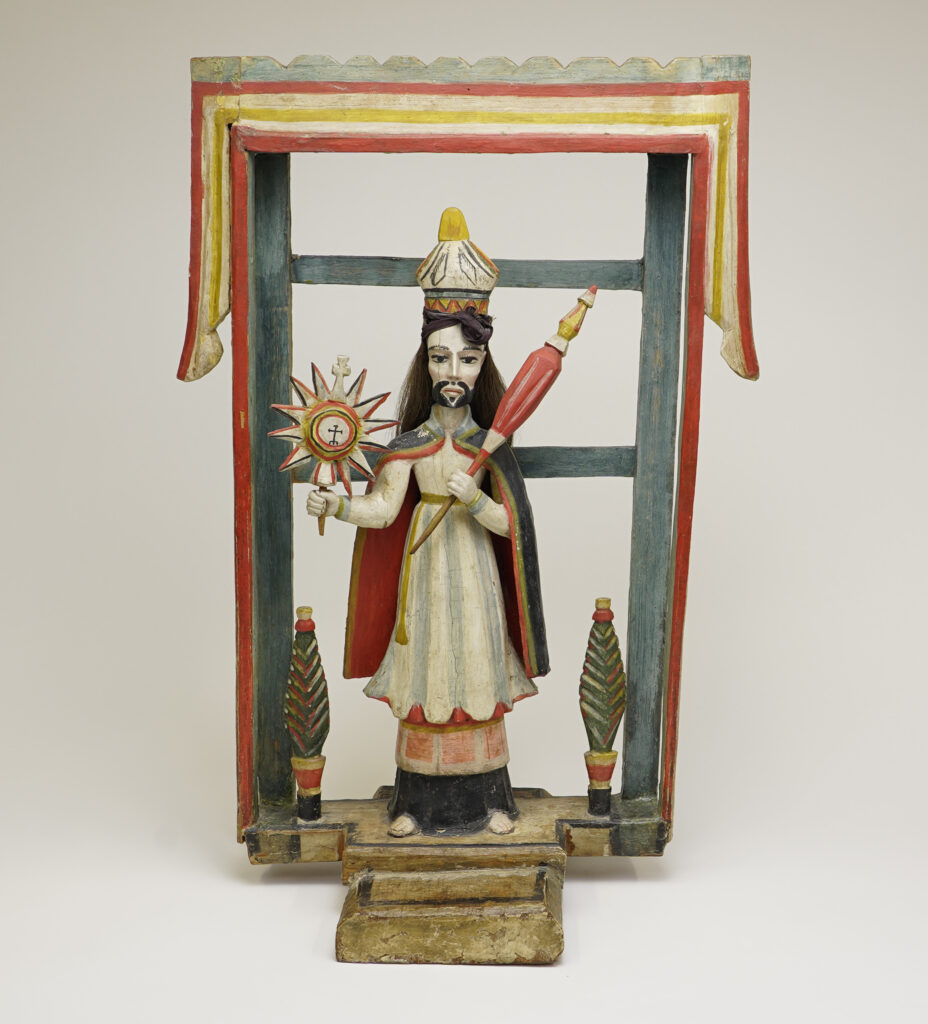
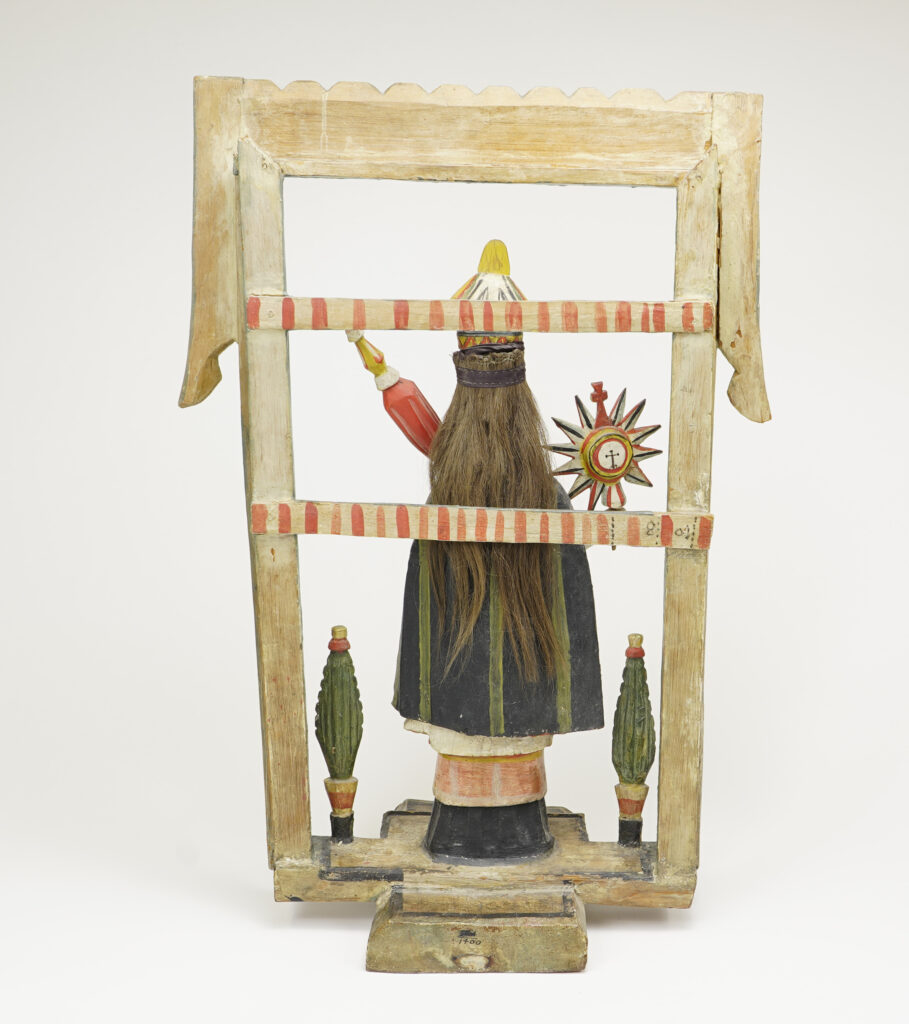
San Ramón es un ejemplo impresionante del arte devocional que se originó en la Capilla de Talpa. El propio San Ramón se encuentra dentro de un marco de madera, pintado con rojos, amarillos y azules desteñidos pero vívidos. El santo es bastante más pequeño que el marco que lo contiene, lo que obliga al espectador a examinarlo desde una perspectiva holística, mientras él sigue llamando la atención del espectador como la figura central. El marco también funciona como un límite que separa a San Ramón del espacio que lo rodea, lo que crea un ambiente por sí mismo. La parte posterior del marco tiene bastante espacio negativo, lo que permite al espectador ver a través de San Ramón y el espacio alrededor. Llama la atención hacia el interior, comenzando desde el marco hacia los objetos ornamentados que él carga, y finalmente, hacia el propio Sán Ramón.
Como pilar de la comunidad, San Ramón sería llevado junto con el Santo Niño al hogar de una madre embarazada para brindarle protección durante su parto. Sin embargo, este San Ramón no fue pensado para uso comunitario como se puede ver en el marco en que fue construido, así como del estado de la base. El aclamado santero Vicente Telles observó que la base sobre la cual San Ramón se posiciona está en buenas condiciones, cubierta por una acumulación de cera. Por lo tanto, no habría sufrido mucho daño en el traslado entre casas. El marco de tal santo probablemente es una indicación de que San Ramón estaba posicionado en el altar de la capilla, con las festones decorativas y las cortinas fluyendo del marco. Esto enfatiza la posición sedentaria que habría asumido. Como se puede observar en la foto original de la Capilla Durán(pagina de inicio), San Ramón se sentaba en la parte de atrás del altar, a mano derecha.
En una mano, San Ramón carga una custodia, un vaso sagrado que muestra la Eucaristía, y en la otra un bastón de madera. El informe original sobre la condición del objeto se refiere a este como un paraguas. El diseño del sol se popularizó para todas las custodias a principios de los años 1500s, y esta representación sigue esta tradición. Los rayos de esta custodia en particular son filosos y dramáticos; inmediatamente atraen la mirada de uno hacia ellos y crean una sensación severa que contrasta con el bastón en la otra mano de San Ramón. La manera en que Aragón imita el típico vacío en el centro de la custodia es intrigante—como el blanco pasa de ser un tono usado para resaltarlo a un tono que debe desvanecer. Muchas representaciones muestran a San Ramón con un manto sobre sus ropas blancas, pero esta representación es inusual debido a la corona en su cabeza.
Los elementos que podrían ser ignorados, como si fueran apenas decoraciones, son los que tienen los significados más profundos en esta obra. A ambos lados de San Ramón se encuentran pequeñas hojas de palma, sutilmente situados en las esquinas del marco. Las representaciones típicas de los santos sostienen la hoja de palma en su mano izquierda como un símbolo del martirio, pero en esta representación de Aragón, San Ramón está literalmente rodeado por su muerte, un mensaje poderoso que puede mostrar que su significado devocional iba más allá de ser apenas el santo de madres embarazadas. San Ramón murió después de hacerse un cardenal en 1239 y fue llamado a Roma el próximo año por el Papa Gregorio IX. Murió en camino hacia Roma y fue colocado a lomos de un burro que, sin saberlo, caminó hacia la Capilla de Santo Nicolás, la iglesia de su niñez que quedaba cerca a su rancho antíguo. Fue incluido en la martirología romana en 1657 por su dedicación constante a la educación religiosa ante la persecución.
Las líneas verticales del marco establecen el confinamiento del objeto, lo que guía al espectador a ver San Ramón como el centro de la obra debido a sus líneas irregulares y su simetría. Sus ropas decoradas, la corona y los hombros redondeados crean una sensación suave que trabaja junto en armonía con la nitidez del marco. La naturaleza geométrica de este santo es pesada, y esta se encuentra en la corona triangular, la estrella tallada y los diferentes rectángulos que el marco tiene. Las coronas tradicionales de los santos frecuentemente eran hechas de estaño y ocasionalmente de plata, algo común que se refleja en otros santos de Talpa, incluso el San Geronimo. La posición de San Ramón en el centro del marco crea simetría, mientras que los elementos asimétricos como el bastón y la custodia crean una curiosidad visual. En muchas representaciones de santos, la decoración es mínima, dado que muchos apenas muestran sus cuerpos y forma física. San Ramón se destaca como un ejemplo de arte folclórico que va más allá del aspecto funcional y incorpora con lo decorativo.
San Ramón ha sido pintado en colores primarios vívidos como el rojo y el amarillo, y también blancos apagados y verdes azules. El acabado de madera natural de la base ofrece elementos terrosos adicionales que contrastan con la naturaleza pintada del resto del santo; esto crea una conexión con la tierra. El rojo es un color que se destaca por todo San Ramón; la viveza por la parte interior de su capa y el bastón rojo son puntos focales primarios. El amarillo se utiliza como un color de acento que incorpora la luz y riqueza. Estos colores brillantes crean un sentido de alegría y vida, lo que se alinea con el propósito de San Ramón de proteger a las madres embarazadas y los bebés recién nacidos.
San Ramón tiene una linda dinámica con el espacio alrededor de él, y crea un diálogo en su inherente inquietud. Al colocarlo en el centro de un marco decorado e intencional, el espectador se siente atraído por el propio santo, y aún reconoce que existe dentro de un contexto artístico y devocional. Este es uno de los dos santos de la Capilla que tiene un marco, lo que levanta la pregunta sobre por qué San Ramón era tan importante para el artista José Rafael Aragón. Se podría interpretar que su naturaleza, clara y poderosa obliga al espectador a acercarse a él, y no lo contrario. Esto le da un poder devocional mayor como un santo que exigía la atención. Estos elementos, sencillos pero impresionantes, garantizan que el enfoque sigue en San Ramón y simultáneamente invitan al espectador a investigar cada detalle pequeño.
In the spring of 1943, H.H. Garnett purchased San Ramón Nonato, or Saint Raymond Nonatus, from the New Mexican Chapel of Our Lady of Talpa. Through manipulation tactics and assertion of colonial power, Garnett brought the contents of the Talpa Chapel to the Taylor Museum, now known as the Colorado Springs Fine Arts Center. During the time when San Ramón was created, New Mexico saw a boom in regional folk art as a result of intense religion and physical isolation. The historical connotation of santos as folk art is highly dismissive of their artistic value, but should be recognized as a historical term used in the discussion of santos.
Mercedarian San Ramón Nonato is the patron saint of confession, childbirth and pregnancy as, in 1204, he was delivered via a cesarean section surgery in which his mother died. In this way, he is considered to have never been born. His sainthood is one of hardship, where on a redemption trip to Algeria he found himself desperate to free slaves despite having no money. He chose to trade himself, his life and body, for the freedom of the slaves, and it was in this captivity that his lips were pierced with a white hot iron and padlocked to stop him from preaching the word of Jesus Christ and thus converting the Muslim population in Algeria. As a New Mexican symbol, San Ramón “bore a special meaning to the colonists of New Mexico who were forever in danger of Indian raids,” making him especially important as a protector of captives and the oppressed.
San Ramón is a striking example of devotional art that originated in the Talpa Chapel. San Ramón himself is situated within a wooden frame, painted with faded yet vivid reds, yellows, and blues. The santo is significantly smaller than the frame which he is contained in, forcing the viewer to examine him from a holistic perspective while still being drawn into him as the central figure. The frame also serves as a boundary that separates San Ramón from the space surrounding him, providing an environment within himself. The back of the frame provides ample negative space, allowing the viewer to see through San Ramón and into the surrounding space. Attention is drawn inward, starting from the frame to the ornate objects he is holding and ultimately to San Ramón himself.
As a community pillar, San Ramón would be brought alongside the Holy Child to the household of an expecting mother to give protection during her birth. This specific San Ramón, however, was not intended for community usage as can be interpreted from the framing in which he was constructed as well as the condition of the base. Acclaimed santero Vicente Telles observed that the base which San Ramón sits on is in good condition, coated with a waxy accretion, and thus would not have been heavily handled in the transportation between homes. The framing of such a saint is a likely indicator that San Ramón was positioned on the altar of the chapel, with the decorative scalloping and flowing curtains of the frame emphasizing the sedentary nature that he would have assumed. As can be seen in the original photo of the Durán Chapel (see home page), San Ramón sat in the back of the altar on the right hand side.
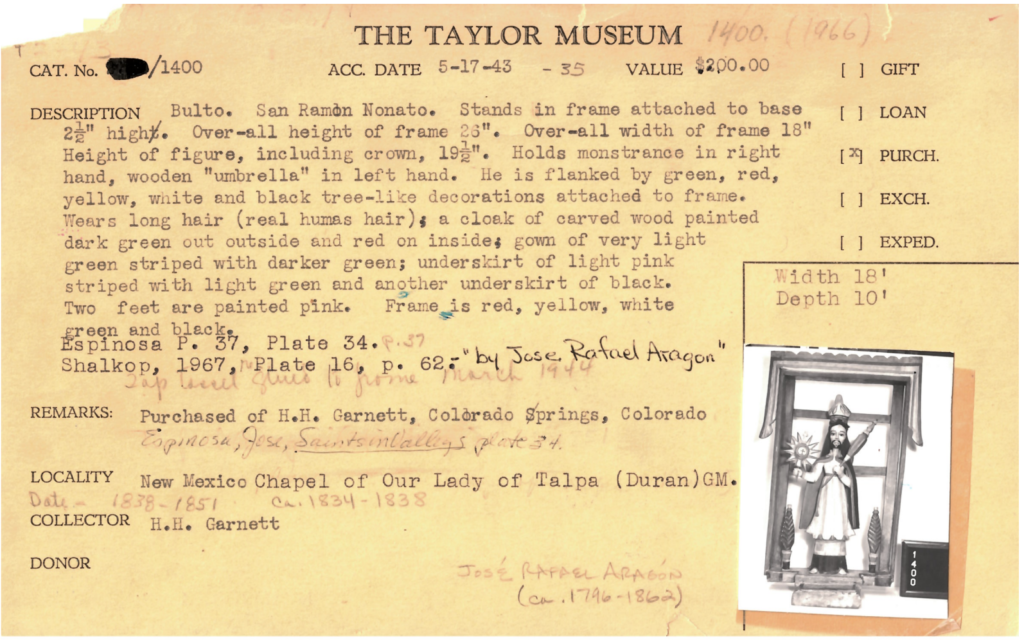
In one hand San Ramón holds a monstrance, a sacred vessel that displays the Eucharist, and in the other a wooden staff, referred to in the original condition report as an umbrella. The sun design became the popular shape for any monstrance beginning in the early 1500’s, and this depiction follows such a tradition. The rays on this particular monstrance are sharp and dramatic, immediately drawing the eye to them and creating a sense of harshness that contrasts the staff in San Ramón’s other hand. The way that Aragón mimics the typical hollowness in the center of the monstrance is intriguing, as white shifts from a shade used to highlight into a shade meant to disappear. Many depictions show San Ramón in a cloak over white robes, yet this depiction is unusual due to the crown that sits on his head.
What could be brushed off as merely decorative holds some of the most profound meaning in this work. On either side of San Ramón are small palm leaves, nestled subtly in the corners of the frame. Typical depictions of saints hold the palm leaf in their left hand as a symbol of martyrdom, yet in this depiction by Aragón, San Ramón is literally surrounded by his death, a powerful message that may show that his devotional significance went beyond just that of being the saint of expectant mothers. San Ramón’s death happened after he was made a Cardinal in 1239 and was called to Rome the next year by Pope Gregory IX. He died on the journey to Rome and was placed on the back of a donkey who, unknowingly, walked to the Chapel of St. Nicholas, his childhood church that was close to his old farm. He was placed in Roman martyrology in 1657 for his unwavering dedication to religious education in the face of persecution.
The vertical lines of the frame establish confinement of the object, guiding the viewer to see San Ramón as the center of the artwork due to his irregular lines and symmetry. His scalloped clothes with his rounded crown and shoulders add a sense of softness that works in harmony with the sharpness of the frame. The geometric nature of this santo is heavy, found in the triangular crown, the carved star, and the different rectangles that the framing provides. Traditional santo crowns were often made out of tin and occasionally silver, a commonplace that is reflected in other Talpa santos including San Geronimo. The placement of San Ramón in the center of the frame provides symmetry while asymmetrical elements such as the staff and monstrance introduce visual intrigue. Ornateness, in many depictions of santos, is minimal, often simply showcasing their body and physical form. San Ramón stands out as an example of folk art that went beyond functionality and into the decorative.
San Ramón has been painted in rich primary colors such as red and yellow as well as muted whites and blue-greens. The natural wood finish of the base provides additional earthy elements that contrasts the painted nature of the rest of the santo, giving a grounded nature. Red is a standout color throughout San Ramón, with the vibrance of the underside of his cape and the red staff being primary focal points. Yellow is used as an accent color that provides light and richness. These bright colors create a sense of joy and life, aligning with San Ramón’s purpose of protecting expecting mothers and newborn babies.
San Ramón is beautifully dynamic with the surrounding space, creating dialogue in his inherent stagnance. By placing him in the center of a decorated and intentional frame, the viewer is drawn to the santo himself while still recognizing that he exists within an artistic and devotional context. This is one of two santos from the Chapel which has framing, raising the question of what made San Ramón so important to artist José Rafael Aragón. It could be interpreted that his clear and powerful static nature forces the viewer to come to him rather than the reverse, placing a higher devotional power onto him as a santo that demanded attention. These simple yet stunning elements ensure that focus is held on San Ramón while still inviting the viewer to examine every little detail.
Este texto fue escrito por Greta Patterson (CC ’25).
This text was written by Greta Patterson (CC ’25).